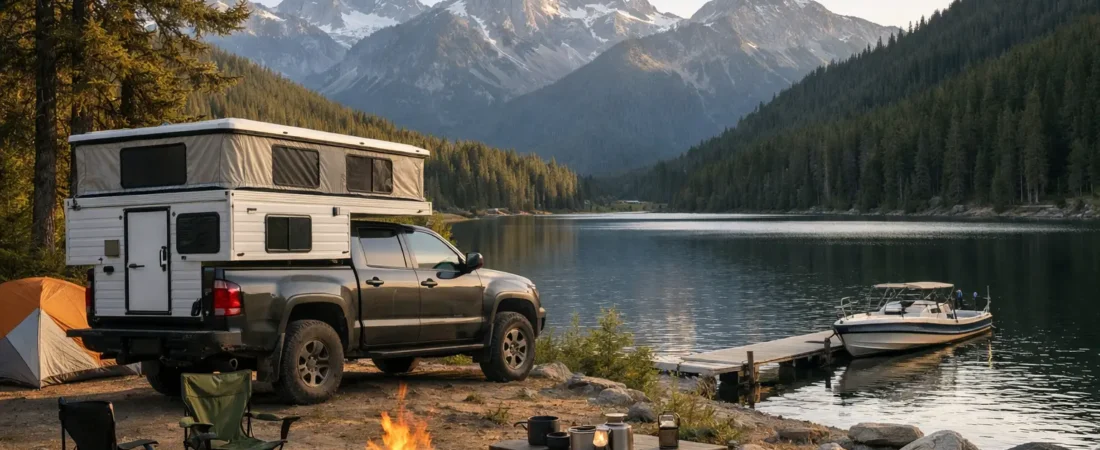
A truck can take you farther down a forest road than a big RV, but that does not mean every pullout is a campsite. When people ask, “where can trucks camp,” the real answer is usually about land rules, vehicle size, access, and whether you can settle in without becoming somebody else’s problem. The good news is that a pickup, truck camper, or overland setup gives you plenty of realistic options.
Our Ram 3500 dually with a Four Wheel Camper Project M is built to get us outside, not to make every road into an obstacle course. Sometimes the best camp is a quiet public-land spot. Other times, especially after a long drive, a simple established campground with a level pad, a picnic table, and zero guesswork is exactly right.
Where Can Trucks Camp Legally?
Trucks can camp in established campgrounds, on certain public lands, in designated dispersed camping areas, and at some private campgrounds. The key word is designated or allowed. A place that looks empty is not automatically open for overnight camping.
Developed campgrounds
State parks, national forest campgrounds, county parks, Corps of Engineers campgrounds, and private campgrounds are the easiest choice when you want clear rules. They usually provide marked sites, a reservation system or first-come availability, and some combination of restrooms, water, trash service, and fire rings.
For a full-size truck, site length matters more than people think. A dually with a truck camper can fit in places that would never work for a truck towing a long trailer, but tight turns, low branches, narrow one-way loops, and short parking spurs can still make a campground frustrating. Before heading in, check the stated maximum vehicle length and look at the site layout when photos or maps are available.
Established campgrounds are also a solid choice when fire restrictions are changing, weather is rough, or you simply want to arrive after dark without hunting for a legal place to stop. There is no prize for turning a tired evening into a navigation exercise.
Dispersed camping on public land
Dispersed camping is camping outside a developed campground, usually on public land managed by agencies such as the Bureau of Land Management or the U.S. Forest Service. This is what many truck campers picture when they think about waking up with nobody parked ten feet away.
It can be a great fit, but it comes with more responsibility. Rules vary by district, season, road, and even by a small section of land within the same forest. Some areas allow dispersed camping for a limited number of days. Others require camping in designated sites only. Some close roads during wet periods, fire season, wildlife protection periods, or restoration work.
In the western United States, public land often creates more dispersed options than heavily developed regions. Still, do not assume public land means open land. Check the specific managing office’s current rules before you go, especially if your route crosses multiple jurisdictions.
Designated dispersed sites
Some national forests and recreation areas split the difference between a formal campground and totally open dispersed camping. They provide numbered roadside sites, simple clearings, or marked camping corridors. These places may have no hookups and few amenities, but they help protect the landscape by keeping traffic, fire rings, and waste concentrated in appropriate areas.
For truck camping, these sites are often the sweet spot. You get a little room, an established place to park, and less uncertainty about whether you are permitted to stay. They can fill quickly on weekends, so having a backup plan is still wise.
Private campgrounds and rural properties
Private campgrounds can be especially useful near popular towns, lakes, trail systems, and event areas where public camping is limited. They range from basic grassy fields to well-organized parks with showers and electrical hookups. A truck camper may not need much, but a reliable power source, a shower, or a place to dump trash can reset the whole trip.
Privately owned land is another possibility only with direct permission from the owner. Do not confuse an unoccupied lot, ranch road, field edge, or boat ramp with an invitation. A quick conversation and clear permission are better than an awkward knock on the camper door at 11 p.m.
Can Trucks Sleep Overnight in Parking Lots?
Sometimes, but parking overnight is not the same as camping. A business, casino, travel center, truck stop, or large retailer may allow overnight parking at its discretion, but local ordinances, property management policies, and posted signs control the answer. Permission at one location does not carry over to another location in the same chain.
If you need a one-night stop while traveling, ask management directly, park out of the way, keep the setup contained, and leave early. Do not put out an awning, chairs, a firepit, leveling blocks, or anything else that turns a parking space into a campsite. The goal is rest, not recreation.
This distinction matters for truck campers because it is tempting to think a self-contained rig is invisible. It is not. A clean, quiet overnight stay may be tolerated where a full camp setup would not be. Respecting that difference helps preserve the option for the next traveler.
Finding a Truck Campsite That Actually Fits
A legal campsite is only useful if you can safely reach it and park there. Full-size pickups have a wider turning radius, greater height, and more weight than a stock SUV or a Jeep. A road that is technically open may still be a bad decision after rain, snow, or a season of washouts.
Before committing to a remote route, consider four things:
- Road width, sharp turns, low branches, and whether there is room to turn around.
- Ground conditions, including mud, sand, deep ruts, loose climbs, and washboard.
- Campsite dimensions, particularly a level parking area and enough room for doors or a rear access area.
- Cellular coverage, weather changes, and how far you are from a paved road if something goes sideways.
Our Ram’s Carli Dominator suspension, ARB air lockers, and Carbon Offroad winch add capability, but they do not change the basic rule: avoid putting a heavy truck in a situation that requires recovery just to reach camp. Capability is useful. Good judgment is better.
A truck camper also makes height a bigger deal. Tree limbs that clear a bare pickup may scrape solar panels, roof vents, awnings, or the camper itself. Our roof carries 600 watts of Renogy solar, so low branches are not a minor detail. Slow down on unfamiliar forest roads, and do not be afraid to park early and walk ahead.
Camp Like You Want the Spot to Stay Open
Truck camping has gotten more popular, and the places people love are under more pressure because of it. That does not mean you need to camp like you are in a museum. It means use existing sites when possible, stay off soft ground, pack out every bit of trash, and leave your campfire plan flexible.
Fire restrictions can change fast, particularly across Texas, New Mexico, and the broader West. A propane firepit may be allowed in some places during restrictions, but not all restrictions treat propane devices the same way. Check the current local order, not an old comment thread. If fires are not allowed, dinner and camp conversation can still be good without one.
The same goes for waste. Being self-contained helps, but it does not make it okay to dump gray water, leave food scraps, or create a new bathroom spot beside camp. Bring what you need to manage waste properly, and leave the site looking like nobody needed a restroom, cooked a meal, or watched the sunset there.
A Better Way to Plan Truck Camping Stops
The most relaxed trips usually have layers. Pick a primary campsite or area, identify a second option nearby, and keep one easy campground or legal overnight stop in reserve. This matters when a road is closed, a favorite pullout is occupied, or a storm turns an unpaved route into a bad idea.
It also helps to arrive earlier than you think you need to. Late arrivals make every obstacle feel bigger: the narrow bridge, the confusing road sign, the occupied site, the branch that suddenly seems lower in the dark. Give yourself enough daylight to look around, assess the ground, and decide whether the place feels right.
Truck camping is not about proving how remote you can get. Some of the best nights happen at a basic site with an easy approach, a cold drink from the cooler, and enough quiet to hear the wind move through the trees. Stop feeding the scroll. Find a legal place to park, make it comfortable, and let the world slow down for a while.