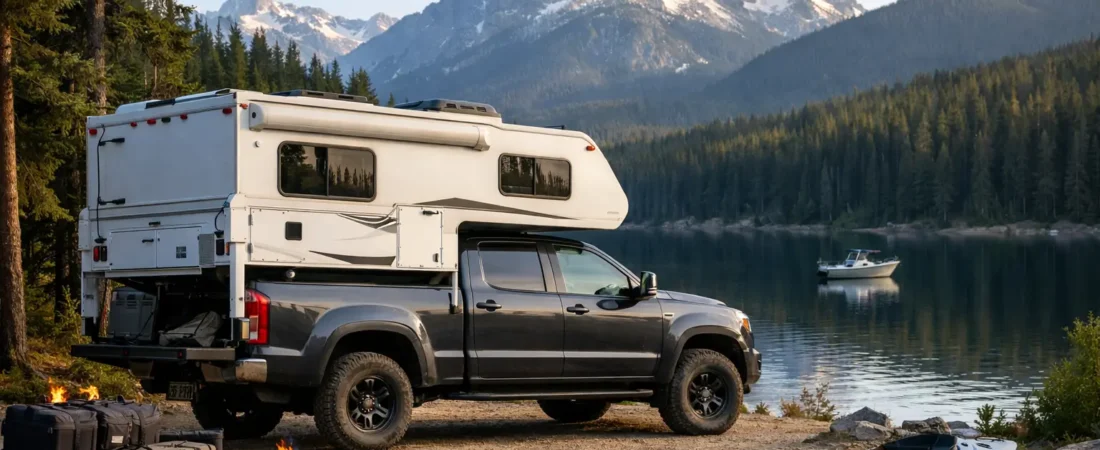
A truck camper can make a regular weekend feel a whole lot bigger. You can leave work, point the hood toward a lake, forest road, or favorite patch of public land, and have your bed, cooler, and coffee setup with you. But truck camper payload is the number that decides whether that freedom feels planted and comfortable or sketchy before you even reach camp.
It is easy to get distracted by the fun parts of a build – solar panels, an awning, recovery gear, cold drinks in the cooler, and enough camp chairs for friends. The less exciting job is accounting for every pound. It matters because the truck carries all of it, not just the camper listed in a brochure.
Our Four Wheel Camper Project M is mounted on a Ram 3500 dually, and that combination is a good reminder that even a very capable truck deserves honest math. A dually can offer substantial carrying capacity and rear-tire stability, but “it’s a dually” is not a payload calculation.
Truck Camper Payload Starts With Your Specific Truck
Payload is the maximum weight a truck can carry in and on the truck. In simple terms, it is the difference between the truck’s Gross Vehicle Weight Rating, or GVWR, and its as-built weight. That carried weight includes people, pets, cargo in the cab and bed, the camper, water, propane, batteries, accessories, and trailer tongue weight if you are towing a conventional trailer.
The most useful starting point is the payload sticker on the driver’s doorjamb. It usually says something close to: “The combined weight of occupants and cargo should never exceed…” That number applies to the exact truck as it left the factory, with its engine, cab, trim, drivetrain, and factory options.
This is why a payload number from an online truck listing is only a rough clue. Two trucks with the same model badge can have very different available payload. A diesel engine, luxury trim, larger cab, four-wheel drive, sunroof, factory steps, and other options all add weight before you load a single sleeping bag.
If the door sticker is missing or unclear, a certified public scale can establish a real baseline. Fill the fuel tank, load the truck as you normally drive it, and weigh it. Then compare that result to the ratings on the door label and tire placard. A scale ticket is much more useful than a guess based on what the truck “looks like it can handle.”
Camper Dry Weight Is Only the First Number
Camper manufacturers commonly publish a dry or base weight. That figure can be helpful for comparing models, but it rarely represents the camper that ends up on your truck for a three-day trip.
Options can change the number quickly. A roof-mounted air conditioner, solar panels, extra batteries, awning, refrigerator, jacks, larger water capacity, bedding, and cooking equipment all count. So do the small things that never make a spec sheet: leveling blocks, tools, a recovery strap, firewood, toiletries, camp chairs, fishing gear, and the stack of snacks that somehow appears every time you leave town.
Water deserves special attention because it is heavy and easy to overlook. One gallon weighs about 8.3 pounds. A 20-gallon fresh-water tank adds roughly 166 pounds when full, before counting the tank itself. Propane, ice, food, and drinks add up just as fast.
A practical payload worksheet should include these categories:
- The camper as equipped, not just its published base weight
- Water, propane, batteries, and fuel carried outside the truck’s normal full tank
- Driver, passengers, pets, and everything in the cab
- Food, clothing, tools, recovery gear, and camp equipment
- Accessories such as awnings, racks, coolers, solar gear, and cargo boxes
- Any trailer tongue weight if a trailer is attached
There is no prize for packing until the truck is right at its rating. Leaving a cushion is smart. Gear changes from trip to trip, scale readings have normal variation, and a truck that is close on paper can become overloaded after one grocery stop and a full water tank.
Weigh the Setup the Way You Actually Travel
The best answer to “Am I within my truck camper payload?” comes from a scale, not an estimate. Ideally, weigh the truck in travel-ready condition. That means the camper mounted, fuel full, water at the level you normally carry, propane aboard, and the people and gear that will actually be in the truck.
Start with the total vehicle weight. It must stay at or below the truck’s GVWR. Then get axle weights if the scale setup allows it. Compare the front and rear axle readings to the front and rear Gross Axle Weight Ratings, often called GAWR, on the door label.
Axle weights matter because truck campers are not always balanced like a load of mulch in the bed. A rear-heavy camper or a lot of gear stored behind the rear axle can put a surprising amount of load on the rear axle and tires. Meanwhile, loading too much weight high up can make the truck feel less settled in crosswinds, curves, and uneven ground.
Tires and wheels are part of this conversation too. Each tire has a load rating, and the combined tire capacity on an axle needs to support the actual axle weight. Tire pressure should follow the vehicle and tire manufacturer guidance for the load being carried. A tire that looks fine in the driveway is not proof it is correctly rated or inflated for highway heat and a fully loaded camper.
Suspension Upgrades Help Control, Not Payload Ratings
Good suspension can make a loaded truck more controlled and more comfortable. Our Ram has Carli Dominator suspension, and the goal with upgrades like that is better ride quality and composure over rough roads, not a magic increase in what the door sticker allows. Air springs, heavier sway bars, shocks, helper springs, and stable-load products can each have a place depending on the truck and camper.
But aftermarket suspension parts do not automatically raise the manufacturer’s GVWR, axle ratings, tire limits, or wheel ratings. They may help a truck handle a load that is already within its ratings. They do not turn an overloaded truck into a properly rated one.
That distinction gets missed because handling and capacity are related but not identical. A truck may feel better after suspension work and still be above an axle or tire rating. Conversely, a truck within its ratings can still need a better setup if it porpoises, leans excessively, or feels unsettled. Address the numbers first, then improve the handling where it makes sense.
Towing Changes the Math
If you tow a regular trailer behind a truck camper, its tongue weight becomes payload. A 600-pound tongue weight is 600 pounds carried by the truck, and it typically lands mostly on the rear axle. That can be the difference between a comfortable margin and an overloaded rear end.
Flat towing is different because a properly connected towed vehicle does not put conventional trailer tongue weight on the hitch. Still, it is not a free pass. Hitch ratings, tow-bar ratings, the truck’s combined-weight rating, braking requirements, visibility, and the added stopping distance all deserve attention. Anyone considering a truck camper plus a flat-towed vehicle should verify every rating for the complete combination rather than assuming the camper is the only load that matters.
Pack for the Trip You Are Taking
Not every trip needs the same loadout. A weekend at a developed campground with water nearby may not require full fresh-water capacity, extra fuel cans, a large recovery kit, or every piece of lake gear. A remote trip can justify more supplies, but that is exactly when the truck needs to be within its limits and handling predictably.
This is where being selective feels good. Bring the gear that makes camp better, not the gear that simply lives in the truck because there was room once. A Dometic or ICECO cooler full of food, a compact fire pit, kayaks, and a shower setup can all make for a great trip. Just give each item a place in the weight plan.
Truck camping is supposed to slow things down, not add a low-grade worry every time a gust hits the side of the camper. Get the real weights, leave yourself room, and then go make coffee somewhere with a better view than the parking lot. Stop feeding the scroll. Come camp with us and let your world slow down.