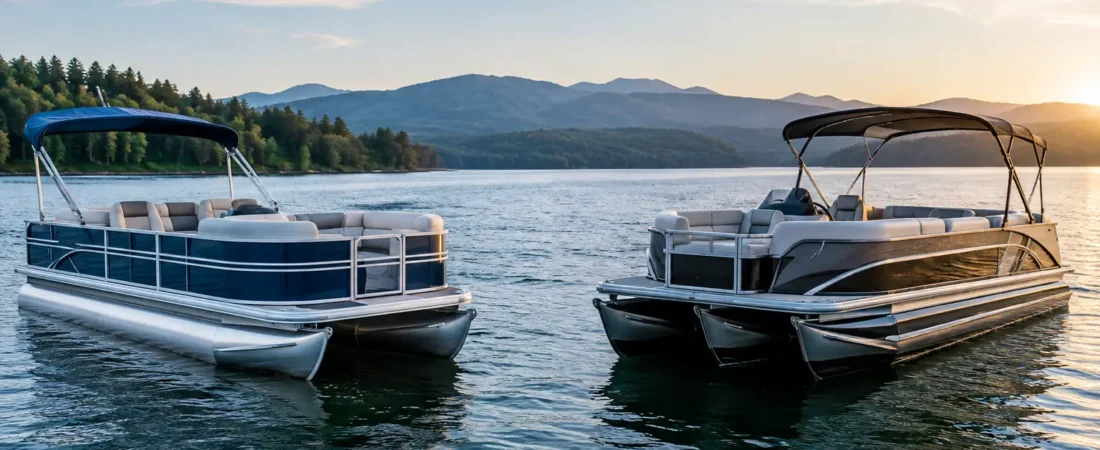
The tritoon versus pontoon question usually starts at the dock, when two boats that look pretty similar from a distance start behaving very differently once the water gets choppy. One may be perfect for slow sunset cruises, floating with friends, and a cooler full of snacks. The other may make more sense when the lake gets busy, the crew wants to pull a tube, and getting home before the afternoon wind kicks up becomes part of the plan.
We use a Manitou XT tritoon for our Texas lake adventures, so three tubes fit the way we like to spend time on the water. But that does not make a tritoon the automatic answer for every family, every lake, or every budget. The better boat is the one that matches the water you run, the people you bring, and the kind of day you actually want to have.
Tritoon Versus Pontoon: The Basic Difference
A traditional pontoon boat rides on two aluminum tubes. A tritoon has a third tube down the center. That extra tube adds buoyancy and can change how the boat carries weight, handles turns, responds to rougher water, and supports larger engines.
The simple version is that a pontoon is often built around relaxed cruising, while a tritoon can be set up for more speed and more demanding lake conditions. But there is plenty of overlap. A well-equipped two-tube pontoon can be a great family boat, and a tritoon can still be the place where nobody is in a hurry and somebody inevitably drops a chip in the water.
Construction details matter as much as tube count. Tube diameter, lifting strakes, hull design, engine choice, seating layout, and overall capacity all affect the ride. That is why comparing two boats by looking only at “two tubes versus three” can lead to a bad shortcut.
Where a Tritoon Makes the Most Sense
A tritoon is often the better fit for larger, busier water. On many Texas lakes, calm mornings can turn into boat chop by midday. Add weekend traffic, wind, wake boats, and a few folks racing toward their favorite cove, and the ride home can get noticeably less relaxing.
The center tube generally gives a tritoon more flotation and stability, especially with a full crew, gear, coolers, and fuel aboard. It also often supports more horsepower. That matters for people who want quicker acceleration, higher cruising speeds, and enough pull for tubing, wakeboarding, or other tow sports.
Handling is another reason people step up to three tubes. Many tritoons feel more planted through turns than a basic two-tube pontoon, particularly at speed. If you enjoy covering a lot of lake in a day, hopping between marinas and coves, or getting back to the ramp ahead of a weather change, that confidence can be worth the added cost.
There is also a practical crew-size factor. A boat can have plenty of seats yet still feel sluggish when every seat is full. A tritoon is often a better match for boaters who regularly bring family, friends, fishing gear, floating mats, and the food required for an all-day lake hangout. Nobody plans to pack light when there is a big swim platform involved.
When a Pontoon Is the Smarter Buy
A two-tube pontoon can be exactly right for calmer water and a more relaxed pace. If your usual trips involve protected coves, smaller lakes, casual fishing, sunset cruises, or anchoring out to swim, you may not need the performance potential of a tritoon.
The biggest advantage is often cost. In comparable sizes and trim levels, a pontoon may cost less to buy than a tritoon. It may also be simpler and lighter, depending on the model and engine package. That can matter when choosing a trailer, considering storage, or figuring out what your tow vehicle can safely handle.
A pontoon can also be a great first boat because it keeps the mission simple: get people on the water comfortably. There is nothing wrong with choosing lower speeds and calmer conditions if that is how your family uses the lake. In fact, spending less on the boat may leave more room in the budget for fuel, safety equipment, maintenance, launch fees, and actual weekends outside.
The mistake is assuming a pontoon is automatically underpowered or incapable. Some are equipped with larger engines and upgraded tube packages, while some tritoons are configured primarily for relaxed cruising. Read the capacity plate, review the specific model’s ratings, and think about its intended use rather than buying based on labels alone.
Ride Quality Depends on Your Lake
This is the part of the decision that is hardest to understand in a showroom. A lake can be glassy at 8 a.m. and bumpy enough to rearrange your cooler by 2 p.m. The water you use most should have more influence on your choice than the water you hope to use once a year.
On smoother water, the difference between a pontoon and tritoon may feel small at cruising speeds. Once you encounter chop, cross-wakes, and heavier boat traffic, the third tube can make a more noticeable difference in how the boat tracks and carries its passengers. It is not a magic force field. You still need to slow down, trim appropriately, watch your route, and respect changing conditions. But a tritoon is commonly better suited to those rougher stretches.
If possible, take a test ride on the kind of water you normally run. Try the boat with more than just a salesperson aboard. Sit in different areas, make a few normal turns, and pay attention to how it feels at low speed as well as cruising speed. A boat that feels great for ten calm minutes may tell a different story after a wakeboard boat passes close by.
Power, Towing, and the Real-World Load
Horsepower is part of the tritoon versus pontoon decision, but it is not a bragging-rights contest. It is about how the boat performs with the load you actually carry.
A couple cruising with a small cooler has very different needs than eight adults, kids, life jackets, tow ropes, a floating island, and enough drinks for a long summer afternoon. More power can help a boat plane more efficiently, maintain speed with a loaded deck, and pull riders with less strain. A tritoon often provides the platform for those bigger engine options.
That said, bigger engines use more fuel and raise the purchase price. They can also raise insurance, maintenance, and trailer requirements. Do not buy maximum horsepower simply because it is available. Think about whether you want fast cruising, tow sports, and frequent full-capacity outings, or whether your happy place is a quiet cove at a comfortable pace.
Trailer weight deserves the same honest look. A tritoon, especially with a larger engine and loaded trailer, can be substantially heavier than a basic pontoon setup. Check the boat’s actual dry weight, trailer weight, fuel capacity, and gear allowance against your vehicle’s towing and payload ratings. A truck that tows confidently makes lake days a lot more enjoyable before the boat even touches water.
Cost Is More Than the Sticker Price
The price difference between a pontoon and tritoon can be meaningful, but the total ownership picture matters more. Along with the initial purchase, plan for registration, insurance, storage, maintenance, trailer service, fuel, batteries, safety gear, and the occasional item that somehow breaks right before a long weekend.
A tritoon may cost more up front, but it can make sense if it keeps you from outgrowing the boat quickly. A pontoon may be the better value if it meets your needs without adding performance you will rarely use. Neither choice is a bargain if it sits unused because it is too hard to tow, too expensive to run, or simply not the kind of boat your crew enjoys.
Before deciding, write down four things: your typical passenger count, the conditions on your home water, whether tow sports are a priority, and what your tow vehicle can manage. Those answers usually narrow the field faster than a brochure full of shiny options.
Choose for the Days You Will Actually Have
For us, a tritoon fits the way we use our Manitou XT around Texas: lake days with room to spread out and the flexibility to handle more than a perfectly calm morning. For someone else, a two-tube pontoon may be the better tool for peaceful evening cruises, fishing, and easygoing family time.
The best boat is not the one with the most tubes or the biggest motor. It is the one that gets launched often, carries your people comfortably, and gives you more reasons to put the phone away for a few hours. Pick the boat that makes it easier to stop feeding the scroll, get out on the water, and let the day slow down.