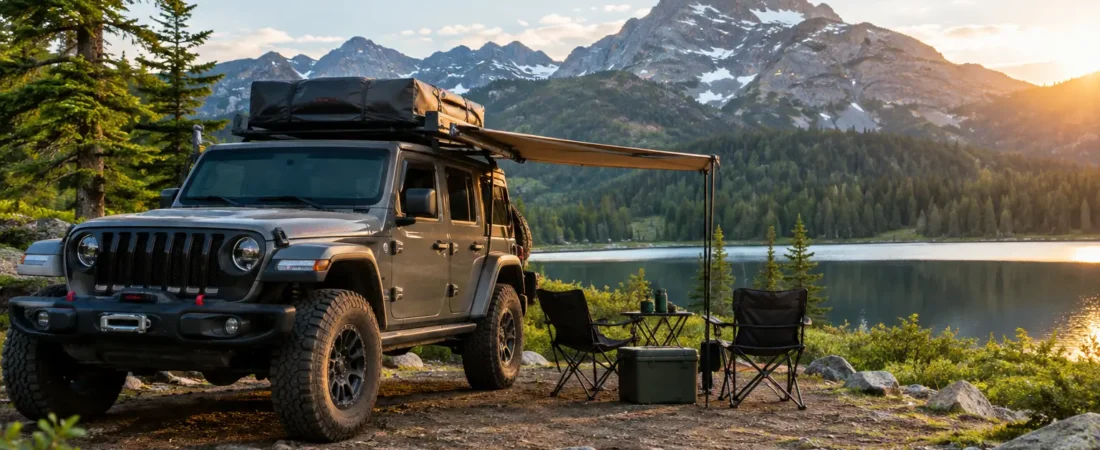
A jeep overland build can get complicated in a hurry. One minute you are thinking about a better place for a recovery strap, and the next you are comparing roof racks, auxiliary batteries, water systems, tire sizes, lights, drawers, and enough bolt-on gear to make the Jeep feel like it needs its own trailer.
We are building out our 2026 Jeep Wrangler Rubicon X for the kind of trips we actually want to take: weekends away, scenic backroads, camp setups with our teardrop trailer, and eventually flat towing it behind our Ram 3500 and Four Wheel Camper Project M. That last part matters. A build makes a lot more sense when it starts with the way you travel, not with a shopping cart.
Start Your Jeep Overland Build With the Mission
Before buying anything, write down what the Jeep needs to do. Not what it might do on an imaginary expedition three states away. What will it do most often?
For some people, that means a daily driver that can handle forest roads and dispersed campsites. For others, it is a trail vehicle that carries recovery gear and gets farther into remote country. Towing changes the equation again. A Jeep that will pull a teardrop needs thoughtful attention to hitch weight, braking, cargo placement, cooling, and payload before it gets loaded down with steel accessories.
Our Wrangler will have a few different jobs. It will tow our teardrop trailer on some trips, travel independently on others, and eventually ride behind the Ram using a Roadmaster Nighthawk tow system with an InvisiBrake system. That means we are thinking about the Jeep as part of a larger travel setup, not as a standalone rock crawler.
There is no wrong mission, but there is a lot of expensive gear that becomes unnecessary when you get honest about yours. A weekend traveler may get far more value from good tires, a simple recovery kit, organized storage, and a camp chair than from a rooftop tent, giant fuel capacity, and 40 inches of light bar.
Build the Foundation Before the Accessories
The Wrangler Rubicon X is already a capable starting point. It has real four-wheel-drive hardware and trail-focused features that let you spend time learning the vehicle before trying to reinvent it. That is a good thing, because a Jeep handles differently once weight starts accumulating.
Tires, protection, and useful clearance
Tires are usually one of the first changes worth considering. The right all-terrain or mud-terrain tire depends on where you drive, how much highway time you cover, the weather, and whether the Jeep tows. Larger tires can add clearance and improve traction, but they also affect gearing, braking feel, fuel economy, steering, and spare-tire fitment.
For many overland-style trips, a quality all-terrain tire is the practical middle ground. It is generally friendlier on pavement, quieter on long road days, and still useful on gravel, dirt, mud, and rough two-tracks. Mud-terrain tires can make sense in consistently muddy terrain or on more technical trails, but they are not automatically better for every camping trip.
Skid plates, rock rails, and properly placed recovery points can be more valuable than flashy accessories. The goal is not to armor every square inch of the Jeep. It is to protect vulnerable areas and give yourself safe options when a rutted road, hidden rock, or sloppy trail creates a problem.
Weight is the quiet budget killer
A steel bumper, winch, roof rack, spare tire carrier, fridge slide, drawer system, extra fuel, water, and camping gear can add up fast. Every piece has a weight penalty, and that weight affects handling, braking, acceleration, suspension wear, and towing confidence.
This is where a Jeep overland build benefits from restraint. Add an item because it solves a recurring problem, not because it looks right in a parking-lot photo. A lightweight solution that gets used every trip is often better than a heavy solution that stays on the Jeep just in case.
It also helps to weigh the Jeep after major changes, especially before towing. Manufacturer ratings are not suggestions, and loading past them does not become safer because the vehicle has cool gear attached to it.
Recovery Gear Should Match Your Skill Level
Getting stuck is rarely part of the plan, but it is part of traveling off pavement long enough. Recovery gear is worth carrying, but it is only useful when you understand what it does and how to use it safely.
Start with the basics: a properly rated recovery strap or kinetic rope, soft shackles or appropriately rated hardware, gloves, a tire repair kit, an air compressor, and a shovel. Traction boards can be helpful in sand, snow, loose dirt, and mud, especially when there is no second vehicle nearby.
A winch may be the right move if your routes regularly include technical trails, steep terrain, mud, or remote travel where self-recovery is realistic. We have a Carbon Offroad Pro 20K winch on our Ram, but a winch choice for a Wrangler should be based on the Jeep’s weight, bumper setup, mounting requirements, and intended use. A winch is not a substitute for good judgment. Neither is a locker, a lift, or that one friend who says, “It’ll probably be fine.”
Practice with recovery equipment somewhere controlled before you need it. Learn where the Jeep’s approved recovery points are. Know how to air down and air back up. And if a recovery situation feels unsafe, stepping back or turning around is a much better story than damaging a vehicle or hurting someone.
Organize Camp Gear Around How You Stop
The best camp setup is the one that does not turn arrival into a 45-minute scavenger hunt. Jeeps are compact, so organization matters more than sheer storage volume.
Think in zones. Keep roadside and recovery gear accessible without unloading camp gear. Store cooking equipment together. Put rain gear, first aid, headlamps, and warm layers where they can be reached quickly. Soft bags and modular bins often work better than a permanent, heavy drawer system for people who use their Jeep differently from one trip to the next.
If you tow a teardrop, let the trailer carry the gear that belongs at camp. The Jeep should not have to haul duplicate kitchen equipment, water storage, and bulky sleeping gear just because there is open space somewhere. Keeping the tow vehicle lighter can make travel days easier.
Power is another place where it pays to avoid overbuilding. A compact power station can run small electronics, camera batteries, lighting, or a cooler depending on its capacity and your needs. We use larger power setups in our truck-camper travel, including an EcoFlow Delta Pro 3 with 600 watts of Renogy solar, but a Wrangler does not need a residential-size electrical system to support a good weekend outside. Match your power plan to actual loads, charging time, and available space.
Add Comfort That Keeps You Outside Longer
Comfort is not cheating. A good shade setup, reliable lighting, cold food, dry clothes, and a place to sit can be the difference between a rushed overnight and a trip you want to repeat.
An awning can be useful in hot, sunny places like Texas, but it needs to be secured and monitored. Wind has a special talent for showing up right after you walk away. Camp lighting should be aimed low and used thoughtfully so it helps your campsite without turning it into a stadium. Rock lights and ditch lights can be useful for visibility and trail awareness, but they should be installed with clean wiring, protected routing, and a real purpose.
A cooler is still one of the simplest upgrades for weekend travel. Whether you use a traditional cooler or an electric model like our Dometic or Iceco units, the practical question is the same: can it hold the food you want, stay secure, and fit the way you pack? The answer may be different for a solo overnight than for a long weekend with a trailer.
Let the Build Grow With Your Trips
The smartest builds are rarely finished all at once. Take the Jeep out as it sits. Keep a note on your phone after each trip: what was annoying, what was missing, what never got used, and what made camp better.
Maybe you learn that you need better storage before you need a lift. Maybe the trailer already provides enough shelter, so a rooftop tent makes no sense. Maybe airing down opens up more roads than any expensive accessory ever could. Those lessons are worth more than a perfect parts list.
A Jeep should help you leave the pavement behind, not keep you stuck in the garage chasing the next modification. Build it for the miles, the quiet mornings, the muddy shoes by the door, and the places where the signal gets weak enough for everyone to look up. Stop feeding the scroll. Come camp with us and let your world slow down.