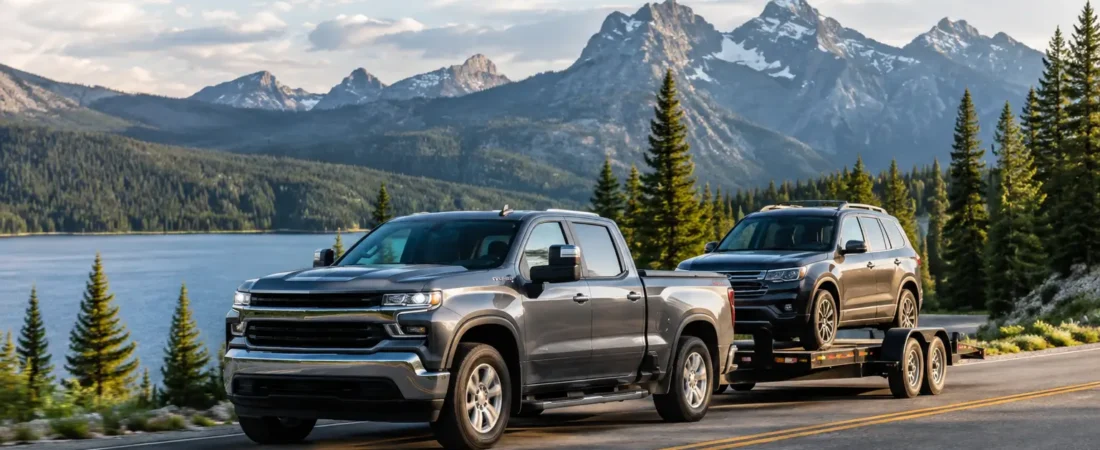
A Jeep rolling behind a truck can make a road trip feel wonderfully simple: camp set up, backcountry road ahead, and no second driver needed. But is flat towing safe? Yes, when the specific vehicle is approved for it and the entire setup is installed, loaded, and checked correctly. When any one of those pieces is guessed at, flat towing can get expensive or dangerous in a hurry.
For us, flat towing is part of the plan for our 2026 Jeep Wrangler Rubicon X behind the Ram 3500 once the Roadmaster Nighthawk tow system and InvisiBrake system are installed. That is exactly why this is not something we want to treat like a bolt-on-and-forget-it project. The appeal is real, but so is the responsibility.
Is Flat Towing Safe for Your Vehicle?
The first question is not whether your truck can pull the vehicle. It is whether the vehicle being pulled can be flat towed at all.
Flat towing, also called four-down towing or dinghy towing, means all four tires of the towed vehicle stay on the pavement. Its transmission, transfer case, steering, and driveline have to be placed in the exact modes the manufacturer requires. Some vehicles are built for it. Others need a dolly or trailer. Some are technically capable only with a very specific procedure, speed limit, or distance limit.
The owner’s manual is the starting line. Look for the recreational towing section, not just the basic towing section. It should spell out whether four-down towing is permitted and explain the required steps. Those details can include putting the transfer case in neutral, placing the transmission in park or neutral, leaving the ignition in a certain position to unlock the steering, or disconnecting a battery cable.
A Jeep Wrangler is commonly flat towed, but that does not mean every Jeep procedure applies to every model year or drivetrain. The same goes for any other vehicle. A friend’s setup, a forum post, or a video can be helpful context, but none of them override the manual for the vehicle in your driveway.
The Tow Rating Is Only One Number
A Ram 3500 has plenty of capability on paper, but a safe setup is more than a big tow rating. The tow bar, baseplate, hitch receiver, safety cables, braking system, and electrical connection all have their own ratings. The lowest-rated component sets the limit.
Weight matters, but geometry matters too. The tow bar should sit as close to level as possible between the truck and the towed vehicle. A bar that angles sharply up or down can handle forces poorly during braking, dips, and uneven pavement. A properly sized hitch drop or rise is not a cosmetic detail.
The baseplate is equally serious. It is the structural connection attached to the towed vehicle, and it needs to be made for that vehicle and installed according to the manufacturer’s instructions. This is one area where careful DIY work or a qualified installer makes sense. A loose fastener hidden behind a bumper is not the kind of surprise anyone wants outside Amarillo with a crosswind blowing.
Also consider real loaded weight. Accessories add up quickly on an overlanding build: recovery gear, tools, a fridge, camping equipment, roof storage, and passengers all change the number. Weighing the vehicle as it will actually travel is more useful than relying on a brochure figure.
Brakes Are Not Optional Just Because It Rolls Easily
A towed vehicle has momentum, even if it feels almost invisible behind a heavy truck on flat highway. Supplemental braking helps the towed vehicle contribute during a stop instead of pushing the tow vehicle forward. It can reduce stopping distances, ease strain on the truck’s brakes, and make the whole combination feel more controlled on grades and in traffic.
Many states and provinces have their own rules for supplemental brakes, breakaway systems, and weight thresholds. Requirements vary, and they can change, so verify the laws for the states on your route rather than relying on an old checklist. Even where a braking system is not legally required for a particular weight, it is still a smart safety decision for most full-size vehicles.
A breakaway system is part of that equation. If the towed vehicle separates from the motor vehicle, the breakaway switch is designed to apply its brakes. The cable needs to be connected correctly every time, with enough length for turns but not so much that it drags. It is not a substitute for proper coupler connections, locking pins, or crossed safety cables. It is the last layer, not the first.
Wiring, Lights, and Battery Power Deserve Attention
The people behind you need to know what you are doing. The towed vehicle needs working brake lights, turn signals, and running lights that match the truck. Before leaving, have someone watch the Jeep while the driver checks left signal, right signal, brakes, hazards, and headlights.
Modern vehicles can also draw battery power while being flat towed. Depending on the manufacturer procedure, the ignition or accessory mode may be needed to keep the steering unlocked, and that can wake up electronics. A charge line from the tow vehicle may help maintain the towed vehicle’s battery, but it should be selected and installed correctly. It is worth understanding the actual draw rather than assuming a battery will be fine after a long day on the road.
This is where a clean, protected wiring install pays off. Cables should not hang low enough to drag, pinch in a turn, or rub against sharp metal. Check them after the first few miles, then again at fuel stops. Road grime has a way of exposing shortcuts.
A Flat-Towing Pre-Drive Routine
The safest habit is a repeatable routine. It takes a few extra minutes, which is a pretty good trade for not wondering whether the transfer case is in the right position 30 miles down the highway.
Before moving, work through these checks:
- Confirm the manufacturer’s four-down towing procedure, including transmission, transfer case, steering, and ignition positions.
- Inspect the tow bar, baseplate attachment points, hitch pin, locking clips, and safety cables for secure connections or visible damage.
- Test the supplemental brake and verify the breakaway cable is connected, routed cleanly, and not pulled tight.
- Check every light function and make sure the towed vehicle’s tires are properly inflated and free of sidewall damage.
- Look underneath both vehicles for hanging wires, fluid leaks, loose gear, or anything that could contact the road.
After pulling out, find a quiet place to make a few gentle turns and one controlled brake check. Then stop after the first several miles and put hands and eyes on the equipment again. You are looking for loose cables, a shifted tow bar, unusual tire heat, or anything that does not look right.
Driving Changes When a Vehicle Is Behind You
Flat towing may track nicely on a smooth interstate, but it changes the way the tow vehicle responds. Leave more following distance, brake earlier, and avoid quick lane changes. Even with a capable truck, a sudden maneuver can make a long combination feel much longer.
Steep descents deserve extra patience. Downshift early and let engine braking help control speed rather than riding the brakes. Watch mirrors regularly, especially after rough pavement, construction zones, or sharp turns into fuel stations. A quick mirror check is not paranoia. It is how small problems stay small.
Backing up is the big limitation. A flat-towed vehicle usually cannot be backed up while connected because the tow bar can bind or damage components. Plan fuel stops, trailheads, and campground entrances with that in mind. Sometimes the safest move is simply to disconnect before pulling into a tight spot. It is mildly inconvenient, but less inconvenient than trying to explain a jackknifed Jeep at the pump.
The Bottom Line Is Preparation, Not Fear
Flat towing is safe when the vehicle is approved, the equipment is matched and properly installed, and the driver treats the connection like real safety equipment instead of a convenience accessory. It is not complicated once the routine becomes familiar, but it is not casual either.
The reward is a flexible camp setup and an easier way to reach the places where the pavement ends. Take the time to do the checks, build the habit before the big trip, and then get back to the good part: fewer notifications, more miles, and a little more room for the day to unfold.