
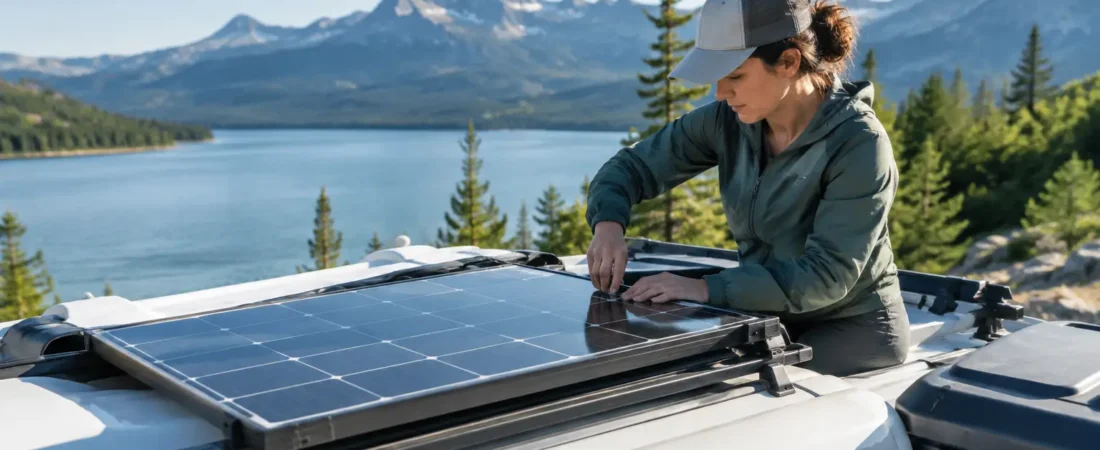
The best reason to install camper solar is not to turn camp into a tiny version of home. It is to stay out one more quiet night without worrying about a dead battery, melting ice, or whether the coffee setup is about to drain everything before breakfast. The trick is building for the way you actually camp, not the way a spreadsheet says you might camp someday.
On our Four Wheel Camper Project M setup, we run 600 watts of Renogy solar on the roof with an EcoFlow Delta Pro 3. That combination makes sense for how we travel in the Ram 3500 dually, including powering everyday camp gear and helping support our EcoFlow AC unit when conditions allow. It is a useful setup for us, but it is not automatically the right answer for every camper. Solar planning gets a lot simpler when you start with your habits instead of panel count.
Start With Your Daily Power Use
Before buying a panel, figure out what needs power after you leave pavement. A camper with a compressor cooler, water pump, LED lights, phone charging, and a vent fan has a very different appetite than one running an induction cooktop, laptop workstation, Starlink, electric blankets, or air conditioning.
Watts describe how much power an item uses at a moment in time. Watt-hours show what it consumes over time, which is the number that matters when sizing a system. A 50-watt device used for four hours consumes about 200 watt-hours. Add up a realistic day, then give yourself margin for inefficient charging, cloudy weather, and the fact that camp plans have a way of expanding once the view gets good.
For a simple weekend truck-camper setup, a modest solar system may be enough to keep a cooler, lights, fan, and electronics happy. Longer stays, shoulder-season travel, and high-draw appliances call for more battery capacity and a more intentional charging plan. Solar is only one part of that plan.
Choose the Right Way to Install Camper Solar
There are two common paths: a traditional fixed electrical system with a battery bank, charge controller, inverter, fuses, and distribution hardware, or a power station-based setup. Both can be excellent. The right choice depends on how much electrical complexity you want to own.
A traditional system is usually the cleaner long-term choice when building out a camper from the ground up. It can be tailored around a permanent lithium battery bank and hardwired loads. It also gives experienced builders more options for expansion, but it requires thoughtful wire sizing, overcurrent protection, component compatibility, and troubleshooting skills.
A power station can make a lot of sense for a removable truck camper or anyone who wants less permanent wiring. The battery, inverter, and many protections are packaged together. You still need to safely route solar cables, protect roof penetrations, and stay within the unit’s solar input limits, but the overall build can be more straightforward. It is also easier to move the power station from the camper to a garage, boat dock, or cabin when needed.
The trade-off is that a power station may not integrate as neatly with every 12-volt accessory, and it can take up usable interior space. Neither approach wins every time. A clean, modest system you understand is better than a giant electrical build that makes every troubleshooting session feel like a final exam.
Roof Solar, Portable Solar, or Both?
Roof-mounted panels are the set-it-and-forget-it option. They start producing as soon as the sun comes up, they do not take up camp space, and they are especially nice for quick overnights when nobody wants to unpack gear. That was a big reason roof panels made sense on our Project M.
The downside is simple: your camper has to sit where the panels can see the sun. Sometimes the best campsite is under trees, beside a canyon wall, or pointed the wrong direction for afternoon light. Flat-mounted roof panels are convenient, but they rarely operate at their perfect angle.
Portable panels add flexibility. You can park in shade and place the panel out in the sun, then adjust it through the day if you want more production. They are useful, but they require setup, storage space, and a little awareness around camp. Wind, curious dogs, passing kids, and a forgotten cable are all part of portable-panel life.
For many campers, roof solar handles the normal routine while a portable panel becomes the backup for longer stays or shady sites. If you mostly move every day or two, roof solar alone may be plenty. If you like to settle near a lake or dispersed campsite for several days, the portable option starts looking more valuable.
Size Panels for Reality, Not Perfect Sun
Panel ratings are a best-case number. A 200-watt panel does not deliver 200 watts all day, every day. Heat, clouds, panel angle, dust, partial shade, wiring losses, and the sun’s seasonal position all affect output. Even a small shadow across part of a panel can cut production far more than most people expect.
That does not mean solar is unreliable. It means it should be treated as a daily harvest that changes with weather and location. Battery capacity carries you through the slow periods. Alternator charging, shore power, or a generator can be useful backup options depending on your travel style.
A practical approach is to size battery capacity first for at least a day or two of expected use, then add enough solar to recover a meaningful portion on a decent day. If you camp mostly in the Southwest during sunny seasons, solar can do a lot of heavy lifting. If you camp in forests, winter weather, or humid storm seasons, do not expect the same result from the same roof.
Protect the Wiring Like It Matters
Solar wiring is not the place to improvise with whatever cable is sitting in a garage bin. Use appropriately rated wire, weatherproof connectors, strain relief, proper fusing or breakers, and a secure roof entry point. The circuit needs protection close to the power source, and every component has voltage and current limits that need to be respected.
For roof-mounted panels, plan the cable route before attaching anything. Think about where the wires will enter the camper, how they will be protected from sharp edges, and whether a future repair will require removing half the interior. Seal roof penetrations carefully using materials suited to your roof type, and inspect them periodically. Water has a remarkable talent for finding the one shortcut nobody planned for.
If this is your first electrical project, get help with the design before drilling holes or crimping terminals. A qualified RV or marine electrical technician can review a plan, and manufacturer manuals should be treated as required reading rather than optional bedtime material. Disconnect power before working, use the correct tools, and do not skip circuit protection just because the system is small.
Do Not Forget How You Will Charge When It Rains
Solar feels magical on a clear day. Three cloudy days in a row are where the rest of the system earns its keep. A dependable camper power plan usually includes more than one charging method.
For many truck-camper travelers, alternator charging is the most useful companion to solar. Driving to a trailhead, fishing spot, or grocery store can put meaningful power back into the battery. Shore power is helpful before a trip and at campgrounds with hookups. A small generator may make sense for specific high-demand use cases, though it changes the quiet character of camp and is not welcome everywhere.
Think through your backup before you need it. If the forecast turns wet, reducing power use is often easier than chasing more power. Charge camera batteries while driving, run the cooler efficiently, use fans thoughtfully, and save the high-draw appliances for when the battery is healthy.
A Solar Setup Should Buy You More Time Outside
The goal is not a roof covered edge to edge with panels just for bragging rights. It is having enough power to keep food cold, lights on, gear charged, and camp comfortable while you pay attention to where you are.
Start smaller than your imagination, but not smaller than your real needs. Keep the system safe, leave room to expand, and learn what your camper uses over a few trips. Then you can spend less time watching a battery app and more time sitting outside after dark. Stop feeding the scroll. Come camp with us and let your world slow down.