A campsite can look perfect right up until you climb into bed and slowly realize your head is lower than your feet. Or worse, every time somebody shifts around in the camper, the whole setup gives a little bounce. Learning how to level truck camper setups is one of those unglamorous camp skills that makes a huge difference once dinner is cooking, drinks are sitting on the counter, and you are ready to stop messing with gear.
With a truck camper, leveling is not exactly the same as leveling a travel trailer. The truck stays attached, the truck’s suspension is part of the equation, and a spot that looks nearly flat can still feel noticeably off inside. The good news is that it does not take much equipment or a complicated process. It mostly takes a slow approach before you unload the coolers and pop the top.
Start by Picking the Flattest Spot You Can
The best leveling gear is a good parking spot. Before reaching for blocks, walk the site and look for the most naturally level patch of ground. A few extra minutes here can save a lot of repositioning later.
Pay attention to more than the obvious slope. Small ruts, tire depressions, loose rock, and soft dirt can change the truck’s stance after it settles. On dirt or sand, a spot that feels fine when you first park may become less level as one tire sinks a little under the camper’s weight.
For most truck campers, side-to-side level matters first. A noticeable sideways lean is uncomfortable when sleeping and annoying at the kitchen counter. It can also affect a compressor fridge’s performance if the camper stays far off-level for a long time. Fore-and-aft leveling still matters, especially for sleep and drainage, but it is often easier to improve by moving the truck forward or backward a few feet.
There are times when a nearly level site is not the best site. If the flat ground puts you in a drainage path, under a dead branch, too close to another camper, or in deep mud, take the slight slope and work around it. Leveling blocks are useful. They are not a reason to ignore the basics of picking a safe campsite.
The Simple Way to Level a Truck Camper
A small bubble level, a leveling app, or the level built into some camper systems can help. A phone works fine if it is placed on a known flat surface inside the camper, such as a countertop. Just remember that some countertops are not perfectly level relative to the camper floor, so learn what yours is doing before trusting it blindly.
Once you are parked, check the camper side to side first. If the driver’s side is low, that side needs to come up. Do not overthink it: place blocks in front of or behind the low-side tires, then slowly drive onto them. Check the level again and add height only as needed.
For a mild lean, one layer may be enough. A more uneven site may need a stepped stack or a purpose-built ramp-style leveling block. The goal is not to make the truck look perfectly symmetrical from outside. The goal is to make the living space comfortable and keep the truck stable.
After side-to-side is close, check front to back. Sometimes moving forward or backward only a foot or two gets you closer without adding another block. If the rear is low, backing onto blocks can help. If the front is low, pulling forward onto blocks may be the answer. Make small changes, then recheck. Big corrections are where people end up pulling onto the wrong part of the block stack and starting over.
Chock the Tires Before Camp Starts Moving Around
Once the truck is where you want it, set wheel chocks. This step is easy to skip when the ground looks flat, but a loaded truck camper is not something to trust to parking brake pressure alone.
Use chocks on the downhill side of the tires whenever possible. If you are parked on leveling blocks, place the chocks firmly against the tires after the truck is settled. On a real slope, chock both sides of at least one tire if conditions allow. The point is to prevent any rolling while people are entering the camper, opening gear compartments, or moving around inside.
Set the parking brake, put the truck in Park, and then chock it. If you are in soft ground, check that the chocks have a solid surface to bite into rather than sitting on loose gravel or tall grass. A chock that slides is mostly decoration.
Use Leveling Blocks That Fit a Heavy Truck
Truck campers put real weight on the tires, especially with water, batteries, recovery gear, coolers, and camping supplies loaded up. Choose leveling blocks designed to handle the weight of your truck and camper combination. Look for blocks with a wide, stable footprint and a surface that grips the tire.
Flat boards can work in a pinch, but they come with trade-offs. They can split, shift, or sink into soft soil. They also do not always create a smooth ramp, which means the truck can climb abruptly onto the stack. If you carry boards, use thick, sound lumber and keep the stack low. Avoid using random scraps that have spent years getting soaked behind the shed.
A ramp-style block system is usually easier because you can pull up gradually, stop at the right height, and secure the setup with a matching chock. It also makes it easier to repeat a successful setup after you have used it a few times.
Never build a tall, narrow tower of blocks under one tire. If you need several inches of correction, consider finding another spot instead. A little slope is generally better than putting a heavy truck in a sketchy balancing act.
Stabilize the Camper, but Do Not Try to Lift the Truck
Leveling and stabilizing are related, but they are not the same job. The tires and suspension support the truck camper. Stabilizers reduce the rocking you feel inside after the truck is parked and leveled.
If your camper has rear stabilizer jacks, lower them until they contact the ground and take out the wiggle. They should be snug, not used to raise the truck or carry a major share of its weight. Overextending them on uneven ground can put unnecessary stress on the camper, jacks, and mounting points.
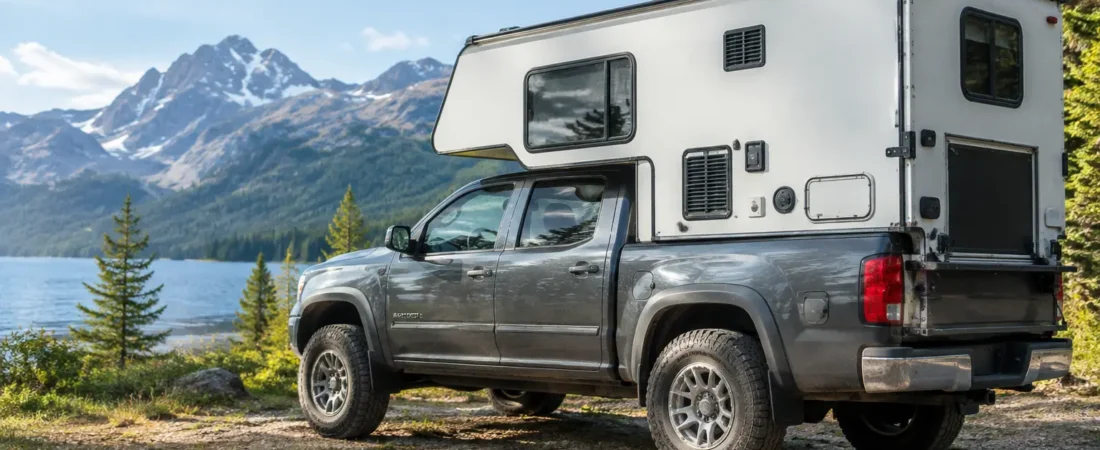
This matters even more with a pop-up truck camper. The camper may be relatively light compared with a big hard-side unit, but movement is still noticeable once the roof is up and people are climbing in and out. Our Four Wheel Camper Project M is mounted on a Ram 3500 dually, and that truck footprint is a helpful starting point, but a stable campsite still comes down to where the tires sit, whether the ground is firm, and whether the camper is properly supported.
If a jack foot is on soft ground, use a broad jack pad or a sturdy block under it. The pad spreads the load and reduces the chance of a jack sinking overnight. Recheck it after the first hour or two, especially after rain or on warm, soft dirt.
A Few Habits That Prevent the Usual Mistakes
Level before setting up the rest of camp. It is much easier to reposition the truck before the awning is out, dinner is on the stove, and every storage compartment is open. The same goes for disconnecting a trailer or setting up chairs. Get the camper right first.
Take it slow while driving onto blocks. Have a spotter if you are traveling with someone. If you are solo, get out and look rather than guessing from the driver’s seat. A block that appears centered can be surprisingly easy to miss with a wide tire.
Do not chase perfection on every overnight stop. If the level shows a tiny lean but you sleep fine, the fridge is happy, and the truck is stable, call it good. Campsites are not kitchen floors. Spending 30 minutes trying to correct a fraction of a bubble is a fast way to turn a relaxing evening into a driveway project.
Before leaving in the morning, walk around the truck. Remove chocks, blocks, pads, and anything tucked under the camper before moving. It sounds obvious, but forgotten leveling blocks have a talent for hiding in grass and under shadows.
Let the Site Set the Pace
A level truck camper makes the small parts of camp better: coffee stays in the mug, food cooks more predictably, and bed feels like bed instead of a slow slide toward one wall. But the point is not to build a perfectly engineered camp pad in the middle of a weekend trip.
Get the truck stable, get the camper comfortable, then put the blocks away and enjoy where you parked. Stop feeding the scroll. Come camp with us and let your world slow down.