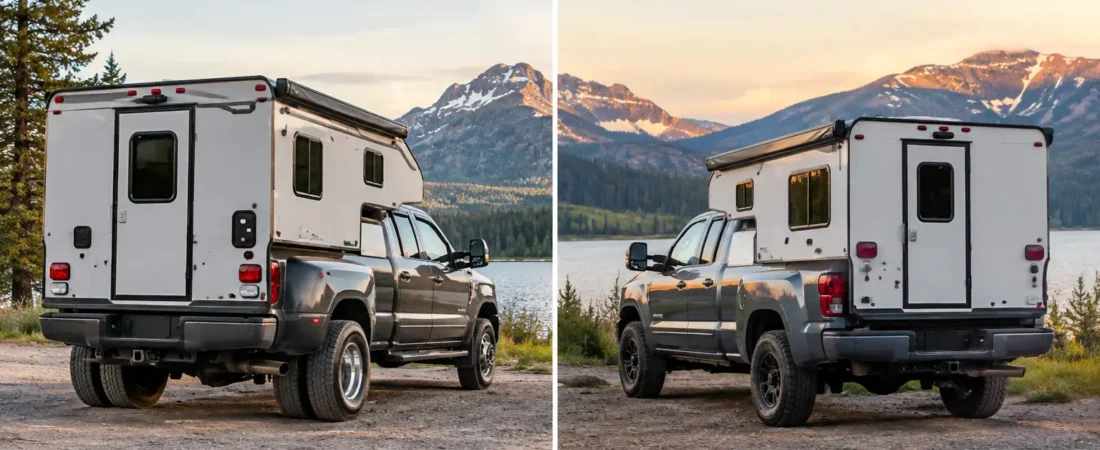
A truck camper can make the dually versus single rear wheel question feel a lot less theoretical the first time you load up for a long weekend. Add fresh water, batteries, recovery gear, food, a cooler, and the little things that somehow multiply before departure, and truck choice becomes about more than what looks good in a parking lot.
We run a Four Wheel Camper Project M on a Ram 3500 dually, so a dually makes sense for our particular setup and the way we travel. But that does not make it the automatic answer for every camper, every road, or every Saturday spent running errands at home. The right choice depends on payload, camper size, where you want to go, and how often the truck has to behave like a regular daily driver.
Start With Payload, Not the Number of Rear Tires
The biggest mistake in this conversation is treating a dually as a universal upgrade. A dually is useful because it typically comes with higher rear axle capacity, more tire capacity, and a chassis designed to carry serious weight. That matters when a truck camper is loaded realistically, not weighed empty on the dealer lot.
A camper’s published dry weight is just the opening number. Water is heavy. Batteries are heavy. A roof rack, solar panels, camp chairs, tools, recovery boards, a fridge or cooler, and personal gear all count. So do passengers and anything mounted in the truck bed. If you tow a trailer or plan to flat tow a vehicle, that can add another layer to the weight conversation.
Before choosing either truck, look at the payload sticker on the exact truck you are considering. Then estimate your actual loaded camper weight honestly and leave room for the gear that will inevitably join the trip. A certified scale is even better once the setup is built. Rear tire ratings, axle ratings, and gross vehicle weight rating are all part of the picture. Payload is not a suggestion, and airbags do not turn an overloaded truck into a properly rated one.
For a lighter pop-up camper, a well-optioned single rear wheel three-quarter-ton or one-ton truck may have plenty of capacity. For a larger hard-side camper or a heavily equipped rig, a dually often moves from nice-to-have to the sensible choice.
Dually Versus Single Rear Wheel: Stability on the Road
The most obvious advantage of a dually is its wider rear stance. With four rear tires carrying the load, the truck generally feels more planted under a tall or heavy camper. Crosswinds, passing semis, uneven pavement, and long downhill grades are where that extra composure tends to matter most.
That does not mean every single rear wheel truck feels nervous. A correctly matched camper, good tires, and quality suspension can make a single rear wheel setup feel very capable. Suspension upgrades can improve control, but they should support a properly matched weight setup rather than excuse an overloaded one.
Our Ram 3500 has a Carli Dominator suspension, and the wider dually rear end is still a meaningful part of how the truck carries the Project M. The suspension helps the ride and control, while the dually gives the camper a broad foundation. Those are different jobs, and it is worth separating them when comparing builds online.
A dually also offers a measure of redundancy if a rear tire fails. With two tires on each side, the truck may remain more stable long enough to get safely stopped. That is not permission to ignore tire maintenance or drive on a damaged tire, but it is a practical benefit when traveling far from home.
The Part Nobody Loves: Width and Daily Driving
A dually is wide. Not mildly wide. It is the kind of wide that makes you pause before entering a narrow drive-through, an older gas station, or a trailhead parking area bordered by rocks and scrub oak.
The rear fenders are the issue, not just the mirrors. They need extra space beside fuel pumps, through construction zones, on narrow forest roads, and in standard parking spaces. Turning tightly beside a concrete post becomes a small event. We would rather park farther out than collect an expensive reminder that the truck has hips.
A single rear wheel truck is easier to place on the road and easier to live with when it is not carrying a camper. It fits better on narrow trails, handles parking garages and grocery-store lots with less drama, and tends to be simpler when the truck also serves as a daily vehicle.
This is especially relevant for overlanding routes. Many scenic public roads are perfectly reasonable in a dually, but some become uncomfortable simply because brush, washouts, narrow gates, and shelf-road edges leave little room for error. If your favorite trips involve tight two-tracks and remote trail systems, a single rear wheel truck may let you relax more.
Off-Pavement Ability Is More Than Tire Count
It is easy to assume a single rear wheel truck is always better off-road, but the answer is more nuanced. A narrower truck can fit through tighter spaces and has fewer rear tires to damage on rocks. It can also be easier to find replacement tires in common sizes, depending on the setup.
A dually, though, is not automatically stuck on pavement. Ground clearance, wheelbase, camper height, departure angle, traction, driver judgment, and route selection all matter. A pop-up camper like the Project M keeps the overall profile lower than many hard-side campers, which helps with wind and clearance. Still, a loaded full-size truck is a large vehicle regardless of rear wheel configuration.
Dual rear wheels can collect mud, rocks, and packed snow between the tires. That gap deserves regular checks, especially after wet backroads or rough travel. In soft sand, a dually’s wider rear footprint can be helpful in some conditions, but there are also more tires to manage and air back up. There is no magic tire arrangement that replaces reading the terrain and knowing when to turn around.
For winter travel, a single rear wheel truck can be simpler for chains because there is one tire per side. Dually chain fitment and clearance need extra attention, and requirements vary by location and tire setup. If snow-covered mountain roads are central to your plans, research chain options before the trip instead of when the weather is already moving in.
Costs, Tires, and the Less Exciting Stuff
A dually has six tires. That means more rubber to buy, rotate, inspect, and replace. Rear tire rotation can be more involved, and matching tire diameter matters. If one tire is damaged, the best replacement decision may depend on tread depth across the paired tires.
Fuel economy can also take a small hit from the added width, weight, and rolling resistance, though camper shape, speed, wind, and load often make a bigger difference on a travel day. Insurance, fender repairs, and some maintenance costs may be higher as well.
A single rear wheel truck is usually less expensive to keep on tires and is easier to find in a wider range of configurations. That simplicity has real value when the truck spends most of its life unloaded or when a trip includes lots of town driving between camp spots.
Which Truck Fits Your Kind of Camping?
Choose a dually when your camper and gear demand the payload, when highway stability under load is a top priority, and when you are comfortable planning around the truck’s width. It is a great tool for carrying a serious camper safely and calmly over long distances.
Choose a single rear wheel truck when your camper is comfortably within its ratings, narrow roads are part of the fun, and daily usability matters as much as camp capability. For many lighter truck-camper builds, it is the more balanced choice.
Neither option is a personality test. A dually is not automatically more adventurous, and a single rear wheel truck is not automatically more practical. Match the truck to the loaded weight you will actually carry and the places you will actually drive. Then leave a little room in the plan for the good stuff: a quiet camp, a hot meal, and a reason to stop feeding the scroll for a while.