A recovery usually starts long before a tire spins. It starts when a sandy two-track looks a little softer than expected, when a rainstorm turns a familiar road greasy, or when a loaded truck settles into a hole that did not look like much from the driver’s seat. The best off road recovery gear is not the biggest pile of stuff you can carry. It is the right set of tools, properly rated for your vehicle, with a plan for using them safely.
For us, that matters even more with a Ram 3500 dually and a truck camper. A heavy rig can get to some beautiful places, but it also asks more of every recovery point, strap, winch, and person involved. The same goes for a Wrangler towing a teardrop. Recovery gear is one of those categories where a little preparation can keep a minor mistake from becoming a very long day.
Best Off Road Recovery Gear Starts With Your Vehicle
Before buying a rope or winch, know what you are trying to recover. Vehicle weight is only the starting point. Mud suction, a steep grade, deep sand, trailer weight, and whether the vehicle is buried to the axles can multiply the force needed to move it.
That is why recovery gear should be sized for the vehicle and the places it actually travels, not just the price tag or the packaging. A lightweight Jeep on forest roads needs a different setup than a loaded full-size diesel truck exploring rough desert routes. If you tow a trailer, remember that the stuck vehicle may effectively be the whole combination.
The first non-negotiable item is a set of proper, manufacturer-designed recovery points. Factory tow hooks or aftermarket recovery points tied into the frame are made for pulling loads. A trailer ball, bumper bracket, suspension component, or random tie-down point is not. Those shortcuts have caused serious injuries and damaged vehicles.
Take a few minutes at home to identify the front and rear recovery points on your rig. It is much easier to do with clean clothes, daylight, and no one waiting behind you on a narrow trail.
A Winch Is the Anchor of a Serious Setup
A winch gives you a controlled way to recover your own vehicle when nobody else is around. That alone makes it one of the most useful pieces of off-road equipment for remote travel. It can pull forward, help a vehicle climb out of a rut, or stabilize a situation while you rethink the next move.
We run a Carbon Offroad Pro 20K winch on our Ram. A heavy truck, camper, and trail conditions can add up quickly, so winch capacity is not a place we wanted to underthink. For smaller rigs, a properly sized winch can still be a better choice than simply buying the highest advertised number available. Mount quality, line condition, electrical connections, and recovery-point strength all matter just as much.
Synthetic winch rope is common for good reason. It is lighter to handle and easier on hands than steel cable, but it still stores energy under load and deserves full respect. Inspect it for abrasion, cuts, heat damage, and contamination. If it is badly damaged, retire it. A winch that has not been maintained is just a heavy ornament on the front bumper.
A winch also needs a solid anchor. That may be another vehicle, a properly protected tree, a ground anchor, or a carefully planned redirect using a snatch block or pulley ring. Never wrap winch rope directly around a tree. Use a tree saver strap to spread the load and protect both the tree and the strap.
Winching Is Slow on Purpose
Good recoveries are usually boring to watch. Everyone not involved stands well clear. Nobody steps over the line. The driver moves slowly and only when directed. The person operating the winch watches the rope spool and stops often enough to make sure nothing is shifting, binding, or getting worse.
A recovery damper can add a measure of protection if a line or connection fails, but it is not magic. Distance, proper ratings, careful rigging, and staying out of the line of pull do far more for safety.
Recovery Rope, Straps, and Shackles
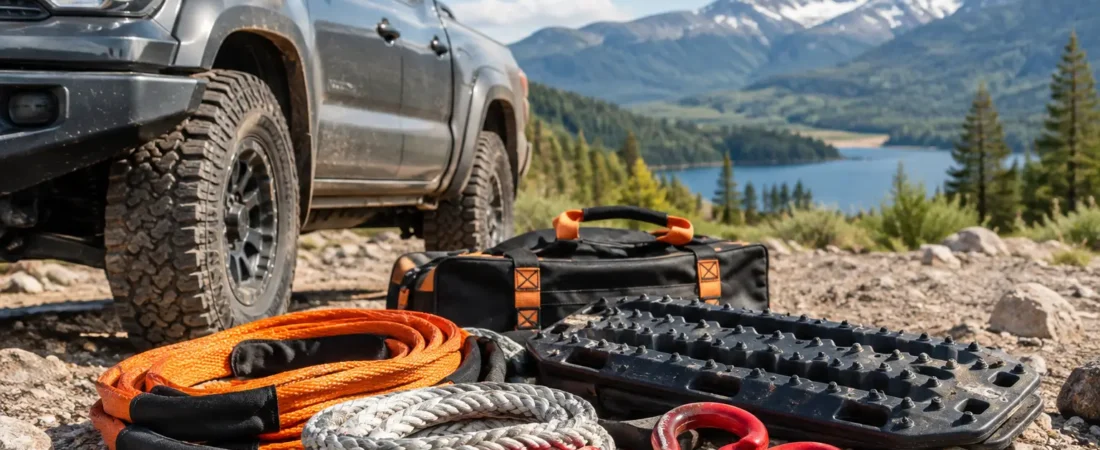
A kinetic recovery rope is one of the best tools for a stuck vehicle that needs a gentle but effective tug. Unlike a static tow strap, a kinetic rope stretches under load and transfers energy more gradually. Used correctly, that stretch can help free a vehicle from sand, snow, or shallow mud without the harsh shock load of a running start.
The key phrase is used correctly. Kinetic recovery takes communication, room to work, and a controlled pull. It is not an excuse to yank on a buried truck at highway speed. The recovery vehicle should build tension smoothly, while the stuck driver helps only as directed. If the vehicle does not move after a measured attempt, stop and reassess. Digging, airing down, changing the pull angle, or using a winch may be the smarter move.
A static recovery strap has a different job. It works well for towing a disabled vehicle over a short distance or creating an extension for a winch line. Do not confuse it with a kinetic rope. The labels, load ratings, and intended use matter.
Soft shackles are useful because they are light, simple to carry, and less likely than metal hardware to become a dangerous projectile if something fails. They still need to be rated, inspected, and used around suitable recovery points. For receiver hitches, use a purpose-built hitch receiver recovery shackle mount, not a ball mount. The ball is for towing, not recovery.
Traction Boards and a Shovel Solve More Than You Think
Winches get the attention, but traction boards and a shovel often solve the problem with less drama. They are especially handy in sand, loose dirt, snow, and shallow mud. Clear material from in front of the drive tires, place the boards as far under the tire as possible, then use light throttle and steady steering.
A shovel earns its space because it lets you change the problem. Instead of forcing the truck through a deep rut, you can remove packed dirt, build a small ramp, clear a path for boards, or uncover a recovery point. It is not glamorous gear, but neither is spending an hour waiting for help because nobody packed one.
For heavier trucks, check the traction board’s load rating and length. A loaded dually brings a lot of weight and tire footprint to the party. Boards can still help, but they are not invincible, and their effectiveness depends on how deeply the vehicle is stuck and what is under the tires.
Air Is Recovery Gear Too
Airing down can be the difference between floating over soft ground and digging four expensive holes. Lower pressure lets the tire footprint spread out, improving traction on sand, rock, and washboard roads. The right pressure depends on tire construction, vehicle weight, wheel setup, terrain, and speed. There is no universal number that works for every truck or Jeep.
That makes an accurate tire gauge and a capable air compressor part of the best off road recovery gear conversation. You need a way to air back up before returning to pavement, especially with a heavy vehicle. Carry a tire plug kit too. A simple puncture repair can save a tow call if the damage is in the tread and the tire is otherwise safe to repair.
If you regularly travel rough roads, practice using the compressor, gauge, and plug kit at home. The first time should not be at sunset with rain moving in and a line of mosquitoes offering management advice.
Build a Recovery Kit You Can Actually Use
A useful kit is organized, accessible, and familiar. If the shovel is buried under camp chairs and the winch controller is somewhere behind the cooler, the gear is not ready when you need it. Keep recovery equipment together in a bag, case, or dedicated compartment, and inspect it after muddy trips.
For most trail travelers, a practical kit includes these essentials:
- Proper front and rear recovery points
- A winch or a plan to travel with a capable recovery partner
- Kinetic recovery rope and static tow strap
- Soft shackles and a hitch receiver shackle mount
- Traction boards and a compact shovel
- Tree saver strap and winch extension, if using a winch
- Tire gauge, air compressor, and tire repair kit
- Work gloves, a headlamp, and a simple first-aid kit
The gear list is only half the equation. Learn basic recovery principles before heading out, and avoid trying a complicated recovery alone if you are unsure about the setup. When conditions are questionable, the safest move may be to turn around, camp somewhere else, or wait for the road to dry. That is not a failed adventure. It is how you get to keep having them.
There is plenty of joy in taking the long way, parking where the stars are brighter, and letting the day slow down. Bring recovery gear that matches the trip, know how to use it, and give yourself permission to choose the easy line when the hard one stops being fun.