
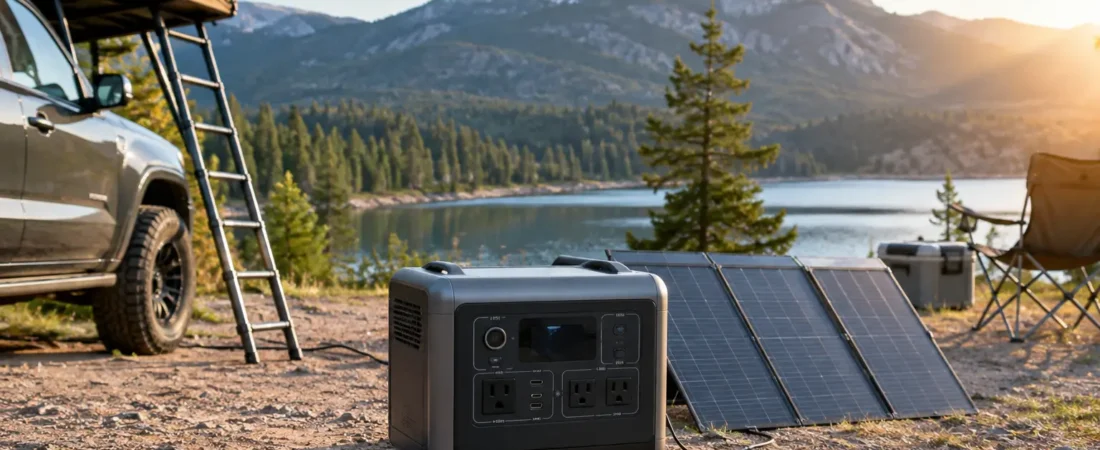
A power station can turn a great campsite into a much more comfortable one – or become 100 pounds of expensive gear you barely use. The best camp power stations are not necessarily the biggest models with the most outlets. They are the ones that match how you actually camp, whether that means keeping a cooler cold for a long weekend, working from a quiet forest site, or running an air conditioner in a truck camper.
We use an EcoFlow DELTA Pro 3 with 600 watts of Renogy solar on top of our Four Wheel Camper Project M, and we also have a Bluetti Elite 300. That setup has made the difference between watching our battery percentage all day and settling into camp without thinking about it much. But it also taught us that capacity, charging speed, and plain old weight all matter more than a flashy spec sheet.
What makes a camp power station worth carrying?
A portable power station is a large rechargeable battery with USB, 12-volt, and household-style AC outlets. For camping, it fills the space between a small phone battery bank and a permanently installed solar-and-battery system. It can run a cooler, charge camera batteries, power lights, and handle appliances that would overwhelm a little 12-volt plug.
The catch is that a power station has limits. A big battery may have plenty of stored energy but still be awkward to move. A compact unit might be perfect for a tent or teardrop trailer, then fall short the moment you add an electric blanket, coffee maker, or portable AC. Solar can keep a system going for days, but panel output depends on sun angle, shade, weather, and how much time you want to spend moving panels around.
For most campers, the best choice begins with watt-hours. Think of watt-hours as the size of the fuel tank. Watts describe how hard the station can work at one time. A 1,000Wh station may keep a 50-watt cooler running for a while, but it will not magically run a 1,500-watt appliance all weekend.
Best camp power stations for different trips
These picks are based on published capabilities, common camping use cases, and the real trade-offs each category brings. Product lines change quickly, so confirm current specifications, dimensions, and compatible solar equipment before buying.
Best overall for truck campers: EcoFlow DELTA Pro 3
The EcoFlow DELTA Pro 3 makes the most sense for campers who need serious stored power and have a vehicle or camper where it can live. Its roughly 4kWh battery capacity, high AC output, and strong solar charging potential put it in a different class from the typical carry-with-one-hand power station.
This is the kind of unit that can support a real camp electrical system: cooler or fridge, electronics, cooking appliances used in moderation, and higher-demand gear. We run our DELTA Pro 3 with 600 watts of Renogy solar on the Project M, which is a useful match for the way we camp. Solar helps replace what we use during the day rather than treating the battery as a one-and-done weekend resource.
The trade-off is obvious the first time you need to move it. This is a heavy power station, not a grab-and-go lunchbox battery. It is best for truck campers, vans, large overland trailers, or base camps where big capacity is more valuable than portability. If all you need is phone charging and a cooler, it is probably more station than you need.
Best high-capacity alternative: Bluetti Elite 300
The Bluetti Elite 300 lands in a useful middle ground for campers who want substantial capacity without committing to the largest power-station class. With about 2.7kWh of capacity, it has enough stored energy for a more demanding weekend setup while remaining easier to place in a truck, trailer, or cabin than a much larger unit.
We have an Elite 300, and its appeal is simple: it gives you breathing room. That matters when the trip includes a powered cooler, camera charging, laptops, lights, and the normal collection of little things that quietly add up. It is also a better fit than a huge unit for people who camp from a teardrop, a Jeep setup, or a vehicle where every square inch has a job.
It is still not light. Plan where it will ride before you buy it, and avoid building a camp system around appliances you would not realistically carry. A larger battery does not make a high-watt appliance efficient. It just lets it drain the battery longer.
Best for weekend tent camping: Jackery Explorer 1000 v2
A modern 1,000Wh-class station such as the Jackery Explorer 1000 v2 is a practical sweet spot for many weekend campers. It is large enough to run a compressor cooler, recharge phones and camera batteries, operate small lights, and handle occasional appliance use. It is also far easier to lift than the big-capacity models.
This size works especially well for tent camping, fishing weekends, and simple teardrop trailer trips. If you are running a Dometic or Iceco-style cooler, the actual runtime will depend on outside temperature, cooler settings, how often it is opened, and whether it starts cold. Pre-chilling food and the cooler before leaving home can save more battery than buying another pile of adapters.
The limitation is reserve capacity. A 1,000Wh unit can feel huge until hot weather turns your cooler into the hardest-working item in camp. Add solar if you expect to stay more than two or three days, but remember that portable panels need direct sun and occasional attention.
Best for fast-moving overland trips: Anker SOLIX C1000
The Anker SOLIX C1000 is worth considering for people who want a compact station with a useful amount of power for quick overnights and constantly changing camps. Its size and capacity class suit a Jeep, a small trailer, or a truck bed where you are already packing recovery gear, water, kitchen gear, and sleeping equipment.
For a road trip with lots of driving, a station in this class can often be topped off while moving between stops, then supplemented with solar when parked. That flexibility is more useful than maximum capacity for people who rarely stay in one place long enough to set up panels.
The key question is whether you are truly mobile. If you spend four nights parked near a lake, a bigger battery and larger solar array may be the smarter path. If your camping looks more like drive, explore, sleep, repeat, a compact unit is easier to live with.
Best for simple camp electronics: EcoFlow RIVER 2 Pro
For campers who mainly need dependable charging, lights, a small fan, and perhaps a low-draw cooler, the EcoFlow RIVER 2 Pro is a sensible smaller option. It is not designed to run a full camper electrical life, and that is fine. Not every outing needs a rolling battery bank the size of a carry-on suitcase.
This class is great for folks easing into powered camping or building a small backup system for kayak launches, fishing days, and one- or two-night camps. It can also serve as a second battery even when you own a larger station. Keeping camera gear and small electronics on a separate unit can be convenient when the main battery is busy with the cooler.
Match your battery to your biggest daily load
Before choosing among the best camp power stations, make a simple list of what will run every day. Include the cooler, lights, charging bricks, laptop, fan, water pump, and anything that makes heat or cold. Heating elements are usually the battery killers. Electric kettles, coffee makers, air fryers, and portable heaters can pull a lot of power in a hurry.
Air conditioning deserves its own reality check. We have an EcoFlow AC unit, but cooling a small space is still a serious energy demand. A large power station can make it possible for limited periods, especially with strong solar and favorable weather, but it is not the same as unlimited shore power. Shade, window coverings, ventilation, and cooling down the camper before the hottest part of the afternoon all help.
Also pay attention to the charging plan. Roof-mounted panels are wonderfully convenient because they work while you drive and camp, but their fixed angle is rarely perfect. Portable panels can chase the sun but take up space and need to be secured. Vehicle charging is useful, though it is usually slower than people expect unless the system supports higher-input charging.
Do not overlook the boring details
The best battery on paper can be frustrating in camp if it has the wrong outlets, a dim screen, noisy cooling fans, or an app you do not need but must use for basic settings. Check whether the AC outlets are accessible in the spot where the unit will ride. Check the AC charging time, solar input limits, and whether the unit can charge while powering your gear.
Weight matters most when camp setup is already tiring. A power station that needs two people to move is still useful, but it should have a permanent, secure home in the truck or camper. Smaller stations earn their keep because you will actually bring them along.
A good camp power station should make it easier to stay outside a little longer, not give you another screen, another app, and another thing to manage. Start with the power you truly use, leave room for the trip to change, and then let the gear fade into the background while the campfire, lake, and long quiet evening take over.