A muddy trail can make mud tires look like the obvious answer. Then comes the two-hour highway drive home, the rainstorm on the way to the lake, or the daily commute where every bit of tire noise suddenly feels louder. That is why the all terrain vs mud tires decision is less about choosing the most aggressive-looking tread and more about being honest about the trips you actually take.
For most of us, the vehicle has to do more than crawl through sloppy trails. It might haul a camper, tow a boat, pull a teardrop, carry groceries all week, and still get us to a quiet camp spot when Friday finally rolls around. The right tire should make those plans easier, not turn every paved mile into a compromise.
All terrain vs mud tires: the real difference
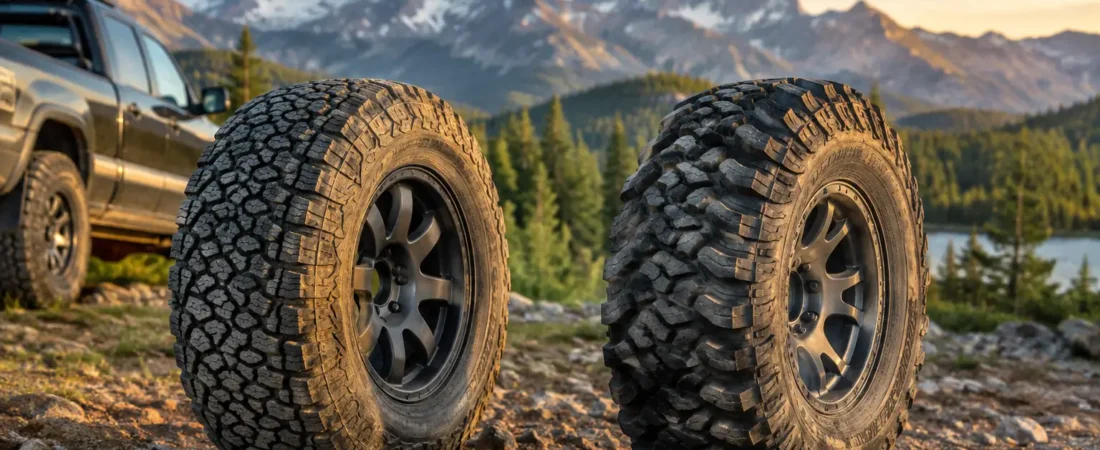
All-terrain tires are designed to split their time between pavement and unpaved ground. Their tread blocks are more closely spaced than a mud tire’s, usually with enough voids, sipes, and shoulder bite to handle gravel, dirt, light mud, snow, and rocky access roads. They are the middle-ground choice, and that is not a bad thing. A lot of outdoor travel happens in the middle ground.
Mud-terrain tires are built around larger, more widely spaced tread blocks and deeper voids. Their job is to clear mud, grab loose terrain, and find traction when the trail is soft, rutted, or ugly. They generally have tougher-looking sidewalls and more aggressive shoulders, which can help when a tire is pressed into rocks, ledges, or deep ruts.
The trade-off is simple: the features that help a mud tire clean itself out in thick mud can make it less pleasant on pavement. Larger tread blocks can create more road noise, wear faster or less evenly, reduce wet-road confidence depending on the tire, and add weight. None of that means mud tires are bad. It means they make the most sense when mud, loose climbs, and serious off-road terrain are a regular part of the plan instead of a once-a-year possibility.
Start with where your vehicle spends its miles
It is easy to buy tires for the most dramatic trail on your wish list. It is smarter to buy for the roads and trails you will repeat all year.
If your usual route includes long interstate runs, pavement through small towns, forest roads, gravel lake access, desert two-tracks, and the occasional rocky trail, an all-terrain tire is usually the more useful answer. Modern all-terrains are far more capable than the old idea of a mild truck tire suggests. On dry dirt, gravel, uneven rock, and moderate sand, a good all-terrain with sensible tire pressure can go a long way.
Mud tires earn their place when the trail itself is the destination. Think recurring clay-heavy roads after rain, deep ruts, loose off-road climbs, muddy hunting property, or trails where a packed tread can stop forward progress. In those conditions, the open voids of a mud tire help throw material out instead of becoming a smooth, mud-covered doughnut.
There is also a seasonal reality. In parts of Texas and the Southwest, hardpack, limestone, gravel, sand, and rocky roads can be more common than deep mud. A mud tire may be overkill for most of those miles. In wetter regions, or on trails with slick clay, the calculation can change fast. Dirt that looks harmless when dry can become a skating rink after one hard rain.
Road manners matter more than people admit
Camping and overlanding videos tend to focus on the fun section of the route. The highway miles rarely make the highlight reel, but they are still part of the trip.
All-terrain tires are usually quieter and more predictable on pavement. Their tread pattern is generally better suited to everyday braking, steering response, and wet-road driving. They also tend to wear more evenly when the vehicle sees a lot of highway miles, provided alignment, rotation, and air pressure are handled properly.
Mud tires can be surprisingly civilized when new, especially compared with older designs, but they are rarely as quiet as an all-terrain. As they wear, the sound can increase. Their heavier construction and aggressive tread can also affect fuel economy, acceleration, and braking feel. On a loaded truck, towing vehicle, or daily driver, those small differences add up.
Wet pavement deserves special attention. Big tread voids do not automatically mean better wet-road traction. Tire compounds, siping, tread design, and remaining tread depth all matter. If you drive in frequent rain, a tire’s wet performance should be near the top of the shopping list, not hidden behind its sidewall style.
Traction is more than tread pattern
A tire is only one piece of the traction puzzle. The best tread in the world cannot fix excessive speed, poor line choice, overloaded axles, or a driver who keeps spinning the tires after momentum is already gone.
Air pressure is a major factor off pavement. Lowering pressure, within safe limits for the vehicle, tire, load, and terrain, increases the tire’s contact patch and lets it conform to rocks, washboard, and loose surfaces. It can make an all-terrain feel dramatically more capable. But airing down also requires a reliable way to air back up before highway speeds, plus the judgment to avoid unseating a bead or damaging a sidewall.
Four-wheel drive, locking differentials, recovery gear, clearance, and patience all matter too. A well-driven vehicle on all-terrains can often travel farther than people expect. On the other hand, no tire choice should be treated as permission to charge into a trail you have not walked, checked, or planned an exit from.
For our kind of travel, that practical approach matters. A Ram 3500 dually with a camper and a Jeep being built for overlanding have very different needs, even if both may end up on dirt. The truck’s tire choice has to account for serious load capacity, towing duties, pavement miles, and the width of a dually rear axle. The Jeep can be set up more specifically for trail terrain. One answer does not fit every vehicle in the driveway.
Load ratings, sizes, and sidewalls are not the boring part
Before choosing all-terrain or mud tires, confirm that the tire meets your vehicle’s required load rating and the weight you actually carry. This is especially important for heavy-duty trucks, truck campers, trailers, and boats in tow. A more aggressive tread does not make up for an inadequate load rating.
Pay attention to the tire’s load range, maximum load capacity, speed rating, and the pressure needed to support the load. Check the tire placard on the vehicle, then factor in modifications and real-world weight. If you travel loaded, getting individual axle weights at a scale is far more useful than guessing based on what the truck “looks like” it can handle.
Size matters beyond appearance, too. Going taller and wider can improve clearance and footprint, but it can also change gearing, affect fuel economy, interfere with suspension components, create rubbing, and alter how the vehicle brakes and handles. Larger, heavier tires put more demand on wheels, brakes, steering, and suspension. There is nothing wrong with a capable tire size. Just make sure it fits the complete setup, not only the wheel well while parked.
Sidewall construction deserves attention if sharp rock is part of the route. Many all-terrain tires offer reinforced sidewalls, while many mud tires lean even harder into puncture resistance. Still, no sidewall is invincible. Slow down around sharp rocks, avoid pinching the tire against an edge, and carry a real spare. A plug kit and compressor are useful, but they are not a replacement for a spare tire on remote roads.
So which tire should you choose?
Choose an all-terrain if your vehicle is a true multi-tool: daily driving, towing, long road trips, dispersed camping, gravel, washboard, moderate trails, and occasional rough weather. Look for a tread pattern with good wet-road performance, the correct load rating, and a reputation for wearing well in the conditions you drive.
Choose a mud tire if regular travel puts you in genuine mud, deep ruts, loose and technical terrain, or trails where open tread and aggressive shoulders are not just nice to have. Be comfortable accepting more noise, potentially faster wear, and a different on-road feel in exchange for that added off-road bite.
If you are stuck between the two, that usually points toward an all-terrain. It is the tire that lets more people leave work, hook up the trailer, load the cooler, and take the long way to camp without making the ordinary miles feel like a penalty. Save the extreme choice for terrain that truly asks for it.
The best tire is the one that gives you confidence to take the trip, while still making the drive home comfortable enough that you will want to do it again next weekend. Stop feeding the scroll. Check the forecast, air up or air down when the situation calls for it, and go find a place where the world slows down.