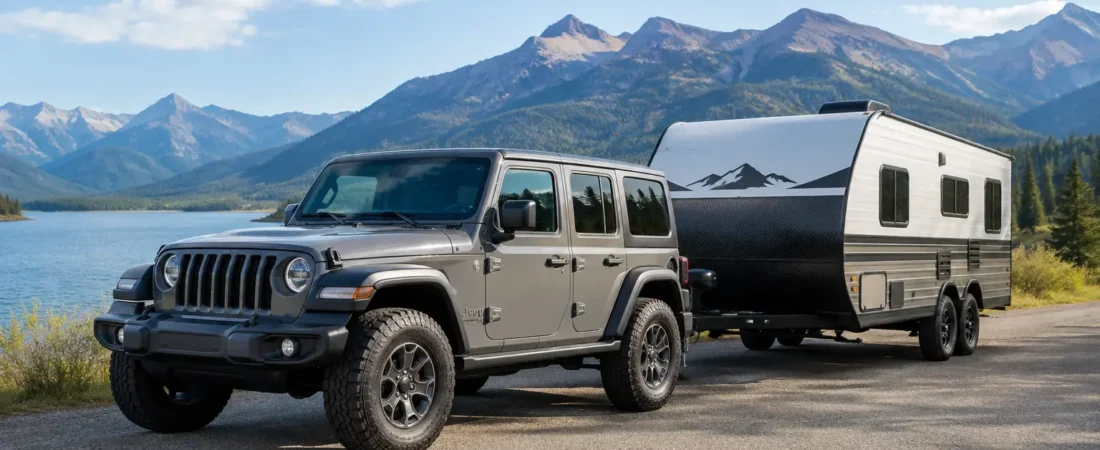
A Jeep can turn a truck-camper trip from “we need to pack up camp to grab ice” into “let’s take the back road and see where it goes.” That is why we plan to flat tow Wrangler behind our Ram 3500 dually and Four Wheel Camper Project M. The Jeep gives us a smaller, more capable way to explore after camp is set, while the truck remains home base.
We have a 2026 Jeep Wrangler Rubicon X, and we are building it for overlanding and towing a teardrop trailer. The next piece is getting it ready to travel behind the Ram with a Roadmaster Nighthawk tow system and an Invisibrake supplemental braking system. Before we hook anything up and point west, though, we are treating the setup like what it is: a towing system with several parts that all need to work together.
Why Flat Tow a Wrangler Instead of Bringing Everything
For the way we like to travel, flat towing makes a lot of sense. The Project M keeps our camp setup compact and capable, but a dually with a camper is not always the vehicle you want to take down a narrow forest road, into a crowded trailhead lot, or through a small town looking for a grocery store. The Wrangler is the vehicle we can use once the awning is out, the cooler is open, and camp has finally slowed down.
A Wrangler is a popular dinghy vehicle because many four-wheel-drive versions can be towed with all four tires on the ground when configured exactly as the owner’s manual specifies. That “exactly” matters. Jeep has changed procedures, drivetrain options, and equipment across model years, so nobody should assume a friend’s setup or an old forum post applies to their Jeep.
Flat towing also has trade-offs. It adds length, connection time, maintenance checks, and another set of tires and brakes to think about. A trailer keeps the Jeep completely off the road, but it takes up more space and creates its own storage and maneuvering problems. For our trips, the ability to arrive, unhook, and explore is worth the added prep.
What a Flat Tow Wrangler System Actually Needs
The tow bar is the part everyone sees, but it is only one piece of the system. A safe flat-tow setup depends on the vehicle-side mounting hardware, a properly rated receiver, safety cables, electrical wiring, and supplemental braking. If one part is wrong, the fact that the others are high quality does not fix it.
Our planned Roadmaster Nighthawk system is designed around a tow bar that stays on the motorhome or tow-vehicle side, along with integrated safety cables and lighting connections. For us, that is appealing because fewer loose pieces usually means less gear to misplace in a dusty campsite. Still, convenience is not a substitute for checking every connection before moving.
The Wrangler will need a base plate or compatible bumper mounting solution made for its specific configuration. This is not the place to guess based on a photo. Factory bumper design, aftermarket bumpers, winches, recovery points, skid plates, and lift-related changes can all affect fitment and towing geometry. Since our Rubicon X is being built out for overlanding, we will make sure every added component plays nicely with the towing hardware before calling the project finished.
A complete setup should account for these four jobs:
- A tow bar and mounting points rated for the Jeep’s actual weight.
- Safety cables that provide a backup connection if the primary connection fails.
- Lighting that clearly communicates braking, turns, and running lights to traffic behind us.
- A supplemental brake system that helps the Wrangler brake when the Ram slows or stops.
The Invisibrake is the supplemental braking system we plan to install. Supplemental brakes are not just a nice extra for a heavy vehicle behind a loaded truck and camper. Requirements vary by state and province, but even where the rules are less specific, extra braking capacity is a common-sense part of controlling the whole combination. It can also help reduce stress on the tow vehicle’s brakes during long grades and surprise traffic stops.
Before You Flat Tow a Wrangler, Start With the Manual
The most important flat-tow tool is not a wrench. It is the owner’s manual for the exact Wrangler being towed.
Read the recreational towing section all the way through, including the warnings. Confirm that your trim, transmission, transfer case, and any drivetrain-related options are approved for four-down towing. Then follow the listed procedure for placing the Jeep in the required transfer-case and transmission positions. Do not rely on memory after the first few trips. A printed checklist in the Jeep or a saved note on your phone is cheap insurance.
The Jeep also needs to be in the correct steering and ignition mode for towing. Depending on the model and system design, that can affect steering-wheel movement, battery draw, and lighting behavior. Verify whether a battery charge line is needed for your equipment. A dead Jeep battery at a fuel stop is a quick way to turn a good travel day into a parking-lot project.
Before the first real trip, it is smart to practice in an open, low-traffic area. Hook up, make slow turns, test the brakes and lights, and confirm the tow bar arms lock as intended. Then stop and inspect everything again. A few minutes of practice beats learning the system while cars stack up behind you at a busy gas station.
A Calm Hookup Routine Beats a Fast One
The goal is not to make hookup exciting. The goal is to make it boring enough that you never wonder whether you missed something.
We plan to use the same sequence every time: park the Ram and Jeep in line on level ground, connect the tow bar, attach the safety cables, connect the lighting cable and breakaway components, then put the Wrangler into its approved towing configuration. After that, we will check brake operation, lights, cable routing, and the position of the tow bar arms before rolling forward slowly.
Cable routing deserves more attention than it gets. Cables should have enough room for turns without dragging, binding, or catching on sharp edges. Crossed safety cables can help cradle the tow bar if it drops, but follow the instructions for the exact equipment rather than mixing advice from different systems. Also look for anything that could contact the Jeep’s tires during a tight turn.
Once underway, the first stop should come early. Pull over after a few miles and look at the whole setup. Check that the tow bar is locked, pins are secure, cables are where they should be, and no warning lights or odd behavior have appeared. That early walk-around is much more relaxing than spending the next 200 miles wondering.
Weight, Height, and the Truck Camper Factor
Flat towing behind a Ram 3500 dually with a Project M is not the same as towing behind an empty pickup. The camper, people, water, recovery gear, coolers, solar equipment, and weekend supplies all count toward the truck’s payload and axle ratings. Then the Jeep adds a towed load behind it.
The ratings that matter are specific to the truck, receiver, tow bar, base plates, and Jeep. Stay within every applicable rating, not just the biggest number you find in a brochure. Tow-bar height matters, too. If the connection between the truck and Jeep is too far out of level, an approved drop or rise accessory may be necessary. That is a fitment question worth measuring carefully, especially after suspension or tire changes.
Our Ram has Carli Dominator suspension, and the Jeep build will also evolve over time. Any change to ride height, bumper equipment, tire size, or recovery gear is a good reason to recheck the towing setup. Modifications are fun right up until two components that once fit cleanly start competing for the same space.
Common Flat Tow Mistakes That Are Easy to Avoid
Most flat-tow problems are not caused by one dramatic failure. They come from a rushed checklist, an assumption about compatibility, or a small detail skipped because camp is calling.
Forgetting the Jeep’s towing procedure is the big one. Another common issue is treating recovery points as automatic tow-bar mounting points. They may look substantial, but they are not necessarily engineered or approved for the forces created by flat towing. Lighting problems, weak battery management, loose pins, and improperly routed cables can also turn a simple travel day into a headache.
It also pays to think about backing up before you need to. A flat-towed vehicle generally should not be backed up while connected. The tow bar can bind, the Jeep can track unpredictably, and damage can happen quickly. Choose fuel stops, campground lanes, and parking spaces with a pull-through exit whenever possible. Sometimes the most off-road thing you can do is skip the sketchy gas station entrance.
Our Flat Tow Wrangler Plan
We are still finishing the installation, so we are not going to pretend we have thousands of towing miles on this setup yet. What we do have is a clear goal: build a Wrangler that can tow our teardrop when it is on its own adventures, then flat tow cleanly behind the Ram when the truck camper is the base camp.
That flexibility fits how we like to travel. No complicated itinerary required. Set up somewhere scenic, unhook the Jeep, find a trail or a quiet lake road, and leave enough room in the day for the unexpected stop that ends up being the best part.
Flat towing a Wrangler is less about buying a pile of parts and more about building a repeatable routine. Take the time to verify the manual, match every component, practice the hookup, and inspect it often. Then the Jeep becomes what it should be: a simple invitation to leave camp for a while, wander a little farther, and come back before dinner.