
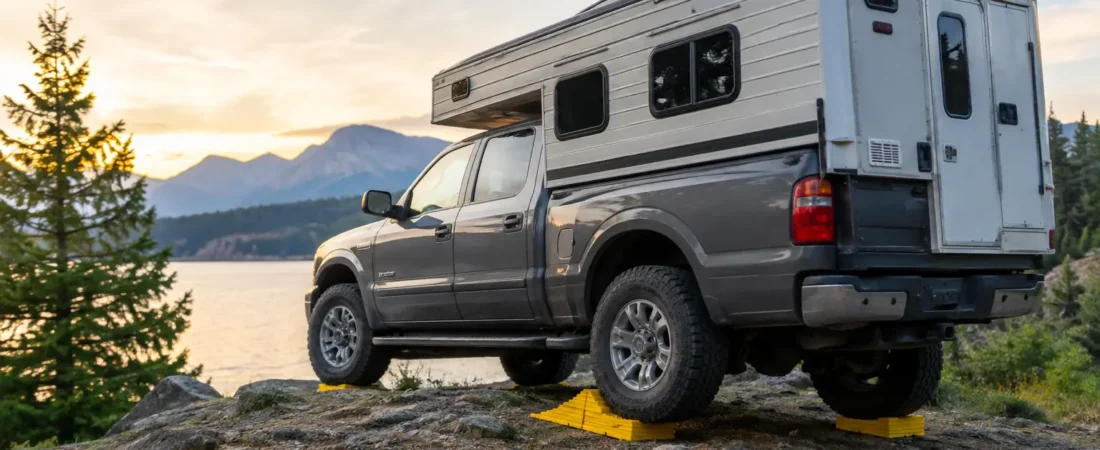
A level truck camper can be the difference between a quiet evening outside and a night spent slowly sliding toward one side of the bed. It sounds like a small setup detail until you are trying to cook pasta that keeps migrating to one edge of the pan, or opening the camper door and realizing gravity has opinions.
With a truck camper, leveling is usually less complicated than leveling a travel trailer. There are no stabilizer jacks doing the heavy work and no need to turn camp setup into a construction project. But a little planning matters. It helps you sleep better, use the camper comfortably, and avoid putting your truck in an awkward position on soft or uneven ground.
Our Four Wheel Camper Project M rides on a Ram 3500 dually, so we pay attention to the site before committing. A dually is stable and capable, but it is also long, wide, and not especially interested in squeezing between rocks or threading through low branches just because the view looks good.
Start by Picking the Flattest Spot
The easiest way to level a truck camper is to need as little leveling as possible. Before pulling into a site, get out and walk it. Look for a naturally flat section that is firm underfoot, has room for the truck, and gives you enough clearance to open doors, deploy an awning, or set up chairs without standing in a drainage ditch.
The best spot is not always the most obvious one. A campsite can look level from the driver’s seat while having a shallow side-to-side lean that becomes very noticeable once you are inside. Check the ground from several angles. If rain is possible, avoid depressions and dry-looking washouts that can become the neighborhood creek overnight.
Try to park with the truck facing either slightly uphill or slightly downhill rather than leaning hard to one side. Front-to-back correction is usually simpler because you can drive onto a leveling ramp or a stack of blocks. Side-to-side correction often means finding a different parking line, which is usually the smarter move anyway.
Why Side-to-Side Level Matters Most
A little front-to-back tilt is annoying, but a strong side-to-side lean is what makes a camper feel strange fast. You notice it while walking, sitting, cooking, and especially sleeping. Cabinets may not behave the way they should, water in a cup will tell on you, and one person may end up owning the whole mattress.
Side-to-side leveling is also where common sense matters most. Do not try to solve a major lean by stacking a tower of loose boards under one set of tires. The truck, camper, passengers, and gear all add up to a lot of weight. If the ground is dramatically uneven, move. That is not giving up on the site. That is choosing a better evening.
For a modest lean, position the low-side tires on leveling blocks or sturdy ramps. Keep the blocks directly under the tires, fully supported, and use products rated for the truck’s weight. A heavy-duty truck camper setup deserves heavy-duty leveling gear. Lightweight plastic blocks designed around a small travel trailer may not be the right answer for a loaded one-ton truck.
Use Simple Tools, Not Guesswork
You do not need a complicated system to level a truck camper, but a few simple tools make the job faster. A small bubble level mounted inside the camper works well because it shows what the living space is doing, not just what the hood of the truck looks like. A phone level app can work too, although phones have a funny habit of disappearing exactly when camp setup starts.
Leveling ramps or stackable blocks are useful for small corrections. Bring wheel chocks as well. Chocks are not optional decoration. Once you have driven onto ramps or blocks, secure the truck before moving around camp or climbing into the camper.
A compact shovel is also worth carrying. Sometimes the fix is not adding height. It is removing a small rock, filling a shallow hole with appropriate material where permitted, or clearing loose debris that prevents a tire from sitting evenly. Avoid altering public land or established sites beyond what is reasonable and allowed. If the site needs major earthmoving, it is probably not the site for that night.
A Safe Way to Level Your Truck Camper
Camp setup gets easier when the process stays the same. First, stop on the flattest line available and check the camper’s side-to-side and front-to-back position. Decide which tire or tires need to come up, then place ramps or blocks in front of those tires. Drive onto them slowly, with a spotter if you are traveling with someone.
Check the level again once the truck is fully positioned. It may take a couple of tries. That is normal. The goal is comfortable and stable, not laboratory-perfect. If you are only slightly off and everything functions normally, there is no prize for burning thirty more minutes chasing a perfect bubble.
After parking, set the parking brake and place wheel chocks. Then walk around the truck and camper. Look at tire placement, ground firmness, overhead clearance, and the angle of the truck. If one tire is perched on the edge of a block or the ground is settling under the truck, reset before unloading gear and making yourself at home.
If you are carrying a hard-sided camper or using the camper off the truck, follow the camper manufacturer’s instructions for jacks and stabilization. A truck-mounted pop-up camper such as the Project M has different needs than a camper that is designed to be unloaded and supported independently. Treat those setups differently.
Protect the Fridge, Then Protect Your Sleep
Older absorption refrigerators were famously picky about being level. Many modern 12-volt compressor fridges are more forgiving, but that does not mean a steep angle is a good long-term parking plan. Check the guidance for your specific refrigerator and avoid assuming every fridge has the same limits.
Comfort is the bigger reason most of us level out. A camper is supposed to make a quick stop feel like a place to settle in. It is hard to slow down when you are bracing a cutting board with one hand or wondering whether you will roll into your partner at 2 a.m.
Leveling also makes the rest of camp feel more intentional. The cooler sits right, the door behaves, coffee stays in the mug, and you can focus on the part that actually matters: sitting outside after the road noise fades. Our setup includes both Dometic and ICECO coolers depending on the trip, and neither one makes a crooked camp any more charming when you are digging around for dinner.
When Not to Level in Place
There are times when blocks and ramps are the wrong answer. Soft sand, mud, loose gravel, snow, deeply rutted ground, and steep slopes all deserve extra caution. Raising one side of a heavy truck on unstable material can create more risk than comfort.
Pay attention to where the weight is going. If a tire is sinking, if the ground is wet beneath a thin crust, or if a ramp keeps shifting as you approach it, stop and reassess. Backing out while the situation is still boring is a lot better than needing recovery gear after dark.
This is especially true with a loaded truck camper. The temptation is to make every scenic pullout work because you have already found it. But there is no shame in continuing down the road, turning around, or choosing the less dramatic site with better ground. The view is still there when you are parked safely.
Build Leveling Into Your Arrival Routine
The best leveling routine is quick enough that you will actually use it. Pull in, walk the site, choose the flattest line, check the camper level, make small corrections, chock the wheels, and then relax. Once that becomes habit, it takes only a few minutes.
Keep your leveling gear where it is easy to reach. If ramps, chocks, gloves, and a small level are buried beneath camp chairs, recovery straps, and half the kitchen, you will be tempted to skip the process. A dedicated bin or exterior storage spot makes a big difference.
There will still be nights when the ground wins. Maybe the site is too off-camber, the soil is too soft, or the only flat patch is directly beneath a low branch. Take that as useful information, not a ruined plan. A truck camper gives you the freedom to move, and sometimes the best camp decision is simply rolling another mile or two down the road.
Stop feeding the scroll. Find a solid patch of ground, make the camper comfortable, and let the evening take its time.