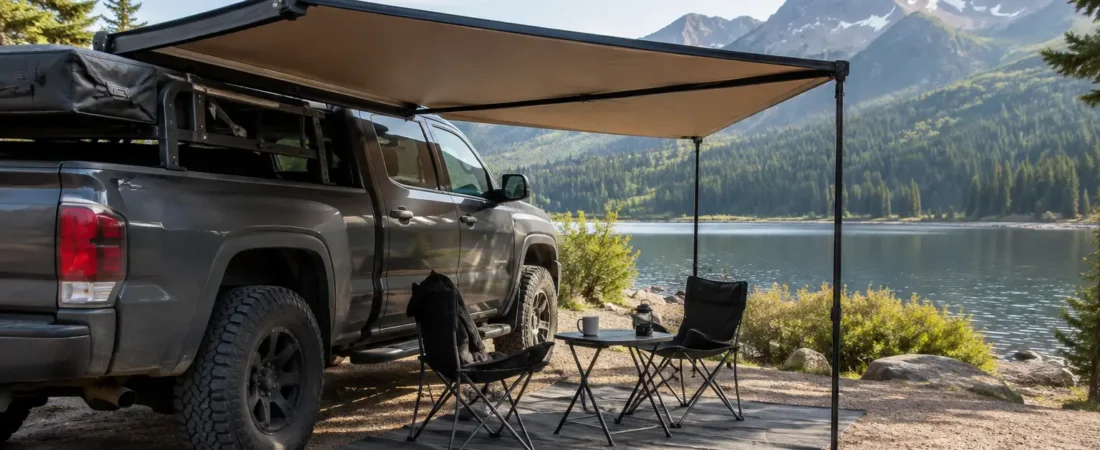
A truck awning can change the whole rhythm of camp. One minute, everyone is packed inside the truck, camper, or teardrop trying to avoid hot sun or a surprise drizzle. A few minutes later, there is a shady spot to make lunch, set out camp chairs, or just sit still and watch the weather roll across the horizon. The best truck awnings do not need to turn your rig into a rolling outdoor showroom. They simply give you more usable space when you need it.
For our Ram 3500 dually with the Four Wheel Camper Project M, an Alu-Cab Shadow awning makes sense because it creates quick shade alongside a truck-and-camper setup that already takes us to some beautiful, exposed places. But there is no single best choice for every truck. A weekend pickup camper, a Jeep with a teardrop, and a long-bed truck carrying a slide-in camper all have different mounting points, wind exposure, and priorities.
What Makes the Best Truck Awnings Worth Carrying?
An awning earns its space when it solves a problem often enough that you stop thinking of it as extra gear. In the Southwest and Texas, shade is usually the obvious reason. Midday sun can make camp feel like a parking lot instead of a place to relax. In wetter country, an awning creates a dry little work zone for cooking, loading gear, or getting boots off before climbing into bed.
The underrated benefit is that it gives camp a center. The space under the awning becomes where coffee happens, where the cooler gets opened too many times, and where everybody ends up after a hike or paddle. That matters when the goal is not to race through a checklist of activities, but to slow down enough to actually enjoy where you parked.
Still, an awning is not magic. It needs a solid mount, a little attention in wind, and a realistic understanding of how you camp. If you mostly stop for one quick lunch and keep moving, a simple hatch tent or small shade canopy may be more practical. If you set up for several nights, cook outside, or regularly camp in open country, an awning starts making a lot more sense.
The Main Types of Truck Awnings
Straight pull-out awnings
A straight pull-out awning is the familiar rectangular style that rolls or folds out from one side of a roof rack, bed rack, camper, or trailer. It usually has support legs and adjustable poles, and it provides a clean strip of shade alongside the vehicle.
This is often the most sensible starting point. Straight awnings tend to be lighter, less expensive, and easier to fit on a broad range of trucks. They work well for a pickup with a bed rack, a camper shell, or a teardrop trailer. The trade-off is coverage. They protect one side of camp, not the rear or the whole kitchen area, unless you add walls or a separate shelter.
They also take more setup than people expect. It is not difficult, but you will be handling poles, stakes, and guy lines. That is fine for a multi-night campsite. It is less fun when you pull over in wind just to make a sandwich.
Freestanding 180-degree awnings
A 180-degree awning wraps around one side and part of the rear of a vehicle. It is a strong fit for truck campers, overland rigs, and trailers where the kitchen, cooler, and camp chairs tend to live beside or behind the vehicle.
The big advantage is useful coverage. Rather than standing in a narrow strip of shade, you can create a real outdoor room. Many 180-degree designs are freestanding in calm conditions, although they still need to be staked down when wind is involved. “Freestanding” should never be translated as “safe to leave open while you go hiking.”
These awnings are heavier and place more load on the mounting system. Before buying, make sure your rack, camper, or mounting brackets are designed for the awning’s weight and leverage. A large awning bouncing down a washboard road is not a small problem just because it is folded up neatly.
270-degree awnings
A 270-degree awning provides the most coverage, wrapping from the side around the rear of the truck or camper. For people who spend a lot of time camped in sun, rain, or changing weather, it can be a huge quality-of-life upgrade. It makes sense on larger rigs with a stable mounting surface and a predictable camp layout.
The downside is simple: more awning means more weight, bulk, cost, and wind management. A big 270-degree model can be fantastic when properly secured. It can also become an expensive sail if weather changes fast. If you routinely camp in exposed desert, prairie, beach, or lakeside sites, plan on using stakes and guy lines every time conditions call for them.
Batwing-style awnings
Batwing-style awnings are a version of the wraparound concept, often opening in a fan shape with multiple hinged sections. The Alu-Cab Shadow awning we carry falls into this broad category. The appeal is quick, generous coverage without building a separate canopy from scratch.
This style is especially appealing for truck campers because it can cover the area where camp naturally happens. But it is not automatically the right answer for every rig. A smaller vehicle may feel overloaded by the size and weight, while someone who camps mostly in dense forests may not need that much shade in the first place.
Choose the Mount Before You Choose the Awning
Awning shopping gets more useful once you stop comparing fabric colors and start looking at your mounting situation. The awning needs a strong, compatible home. That might be a roof rack, bed rack, camper roof rail, cap rack, trailer rack, or purpose-built bracket system.
Measure more than the available length. Check where doors open, where your camper roof lifts, whether you need access to tie-down points, and whether the awning will interfere with a tailgate, rear hatch, or fuel door. On a truck camper, also think about the awning’s location when the roof is raised. A setup that looks perfect in a product photo can become annoying fast if it blocks the door or collides with something during camp setup.
Weight deserves real attention. An awning may weigh far more than it appears to in photos, especially once brackets, mounting hardware, walls, and lights are included. Put that weight high on the vehicle, then add rough roads, wind, and the movement of a tall truck camper. Strong hardware and careful installation are not glamorous, but they matter more than a fancy zippered storage bag.
Fabric, Poles, and Walls Matter More Than Extras
Most quality truck awnings use durable synthetic fabric with some level of water resistance and UV protection. Those details matter, but the real-world difference often comes down to construction: sturdy arms, reliable hinges, reinforced stress points, and hardware that does not feel flimsy after a season of dust and road vibration.
Walls can make an awning dramatically more useful. A single sidewall can block low sun or wind. A full wall kit can create privacy for changing clothes, a dry cooking space, or a sheltered spot during a passing storm. It can also add setup time, storage bulk, and plenty of fabric to manage when everything is wet or muddy.
For many campers, one optional wall is the sweet spot. It gives you flexibility without turning every overnight stop into a construction project. If you want a shower setup at camp, privacy walls can be particularly helpful, though they should be chosen around your actual space and mounting layout.
Wind Is the Real Test
The best-looking awning is not the best truck awning if it only works on perfectly calm days. Wind is where setup habits matter more than brand names. Open the awning fully, use its support legs correctly, stake it down, and add guy lines when conditions call for them. If gusts get serious, bring it in.
That last part is not exciting advice, but it saves money and frustration. Awnings are shade structures, not permanent roofs. We have all seen the kind of gust that arrives while someone is saying, “It probably won’t get any worse.” That is usually the moment to start packing it up.
It also helps to park with intention. Use the truck, trees, terrain, or a trailer to create some protection when possible. This is not always an option in open country, but even a slight shift in orientation can make a noticeable difference.
A Better Buying Decision Starts With Your Camp Style
If you want fast shade for day trips, fishing stops, trail lunches, or occasional weekends, a compact straight awning may be all you need. It is lighter, simpler, and easier to justify.
If your truck is a base camp for several days at a time, a 180-degree or batwing-style awning can make outdoor living much more comfortable. It gives room for camp cooking, coolers, chairs, and those long conversations that somehow happen after the fire has burned down.
A 270-degree awning is worth considering if you have a larger truck camper or trailer setup and regularly use the space around the rear of the rig. Just be honest about whether you will manage the extra weight, cost, and wind precautions. Bigger coverage is great, but only when it matches the way you actually travel.
The right awning is not the one with the most panels or the most dramatic product photos. It is the one you will open often because it makes camp easier. Set it up well, respect the weather, make a little shade, and give yourself another reason to stop feeding the scroll for a while.