
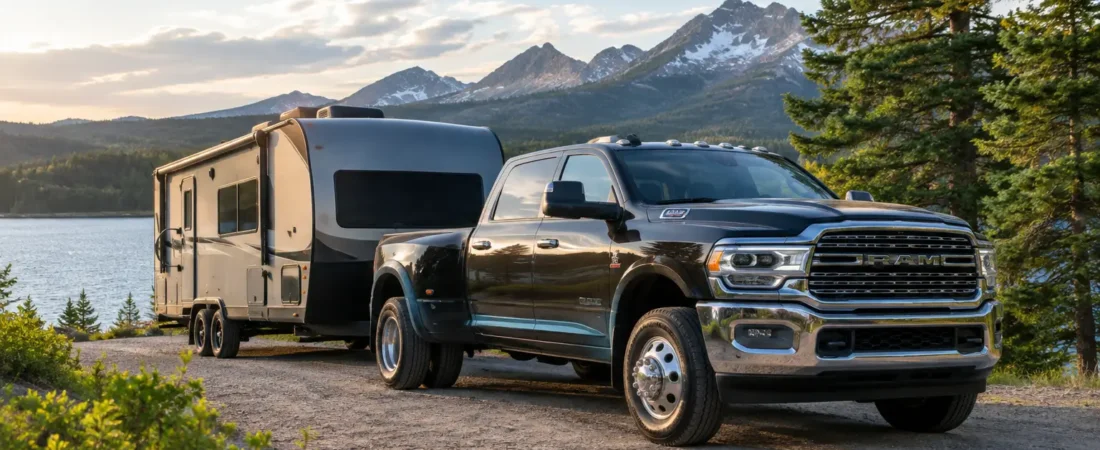
A Ram 3500 can make a loaded trailer feel a lot less dramatic, but this Ram 3500 towing guide starts with the part that is easy to overlook: a big truck does not erase the need to know your numbers. It just gives you more room to work with.
We run a Ram 3500 dually with a Four Wheel Camper Project M, so weight is not an abstract spreadsheet topic around here. The camper, people, recovery gear, water, food, coolers, solar equipment, and the stuff that somehow multiplies before every trip all count. Add a trailer, or eventually a flat-towed Jeep, and the plan needs to be based on the actual truck configuration rather than a best-case towing number from an ad.
Start With Your Ram 3500’s Actual Ratings
Ram 3500 towing capacity varies widely by model year, cab, bed length, axle ratio, engine, transmission, drivetrain, tires, and whether the truck is a single-rear-wheel or dual-rear-wheel model. A diesel dually may be capable of pulling a seriously heavy load, but the number on a similar-looking truck online may not apply to yours.
The place to begin is the sticker and documentation for your truck. Find the truck’s GVWR, front and rear axle weight ratings, tire load ratings, payload figure, GCWR if available, and the specific hitch limits. The yellow door-jamb payload label is especially useful because it accounts for how that particular truck left the factory.
Payload is often the number that catches people off guard. It includes passengers, the camper, cargo in the bed and cab, aftermarket accessories, and trailer tongue weight. A trailer can be well below its stated maximum tow rating while still putting the truck over its payload or rear axle rating.
That distinction matters even more with a truck camper. Our Project M setup is one reason we pay close attention to the loading plan. Things like an EcoFlow Delta Pro 3, solar panels, a Dometic or Iceco cooler, tools, recovery equipment, and water are useful out in camp, but usefulness does not make them weightless.
Ram 3500 Towing Guide: Weigh It Loaded
A public scale is one of the best tools in a towing setup, and it is cheaper than guessing. The goal is not simply to weigh an empty truck once. Weigh the truck the way it travels.
Fill it with fuel. Load the camper, people, coolers, camp chairs, water, and the gear that stays in the truck. Then weigh the full combination with the trailer attached. If possible, get separate axle weights for the front axle, rear axle, and trailer axles.
Those numbers tell a more honest story than dry weights. Trailer manufacturers usually list a dry or unloaded weight, but batteries, propane, water, gear, options, and food can add up quickly. The same goes for a teardrop trailer. It may be light compared with a large travel trailer, yet it still needs a balanced load, proper tire pressure, working brakes when equipped, and a hitch that is within its rating.
For conventional bumper-pull trailers, tongue weight is a major piece of the equation. As a general starting point, many trailers behave best with roughly 10 to 15 percent of total trailer weight on the tongue. Too little tongue weight can contribute to sway. Too much can overload the rear axle, rear tires, hitch, or payload capacity.
Numbers alone do not replace judgment. If the truck feels light in the steering, the trailer pushes through dips, or the rig porpoises over highway seams, stop treating it like a normal characteristic of towing. Recheck loading, hitch height, tire pressures, suspension condition, and weight distribution.
Match the Hitch to the Job
The receiver, ball mount, ball, coupler, safety chains, breakaway cable, and wiring all need to be rated and installed for the weight being towed. The lowest-rated component is the limit. That sounds obvious until a heavy-duty truck gets paired with an old ball mount that was bought for a smaller trailer years ago.
Hitch height matters, too. A truck with a camper, larger tires, or suspension upgrades can sit differently than stock. The trailer should ride level or close to level when loaded. A nose-high or nose-low trailer can change handling and axle loading in ways that are not obvious from the driver’s seat.
Weight-distribution hitches can be helpful for some conventional trailers, but they are not automatically compatible with every truck-camper or receiver setup. They also need to be set up correctly. Check the truck and hitch manufacturer guidance before adding one, especially if a camper affects bed access, receiver clearance, or rear suspension behavior.
Brakes, Tires, and the Boring Stuff That Saves Trips
A Ram 3500 has strong brakes, but the truck’s brakes should not be asked to stop a loaded trailer by themselves. If the trailer has electric brakes, use a properly adjusted brake controller and test it somewhere quiet before joining traffic. The breakaway system should have a charged battery and a cable connected independently to the safety chains.
Trailer tires deserve more attention than they usually get. Check their age, tread, sidewalls, pressure rating, load rating, and inflation when cold. A tire that looks fine in the driveway can still be old, underinflated, or overloaded. Carrying a usable spare, the right lug wrench, and a jack plan is much more comforting than trying to figure it out on the shoulder.
Before leaving, we would rather spend ten calm minutes checking the rig than spend two hours sorting out a problem beside a busy road. A solid pre-trip check includes these five things:
- Confirm that hitch pin, coupler latch, safety chains, and breakaway cable are secure.
- Test brake lights, turn signals, running lights, and trailer brakes.
- Check truck and trailer tire pressures, including the spare.
- Walk around the truck and trailer for loose cargo, open compartments, and hanging cords.
- Make sure the load is secured low and balanced before pulling away.
Towing With a Camper Changes the Feel
A loaded truck camper raises weight and can raise the center of gravity, which means smooth inputs matter. Give yourself more room to brake, turn wider, and slow down before curves. Wind, passing semis, rutted pavement, steep grades, and rough forest roads can all feel different with a camper and trailer behind you.
Our Ram 3500 dually has the stability benefits that come with a wider rear stance and additional rear tire capacity, but a dually is not a permission slip to ignore conditions. Narrow fuel islands, trailhead parking, tight boat ramps, and small-town drive-thrus all require a little more patience. Sometimes the best move is parking farther out and walking an extra minute.
Suspension upgrades can improve control and ride quality, but they do not raise factory axle, tire, hitch, or payload ratings. That is a useful rule to keep in mind with any build. Air lockers, lighting, a winch, awning, and power gear can make a truck more capable and comfortable off pavement, but every added accessory belongs in the overall weight conversation.
Flat Towing Is a Different Calculation
We are building a 2026 Jeep Wrangler Rubicon X for overlanding and plan to flat tow it behind the Ram once the Roadmaster Nighthawk tow system and InvisiBrake system are installed. Flat towing removes trailer tongue weight, but it does not remove responsibility.
The Jeep’s actual ready-to-tow weight still counts toward the combined rating. The tow bar, base plates, safety cables, supplemental braking system, lighting, and breakaway function all need to be compatible with the specific Jeep and Ram setup. A flat-towed vehicle also changes how much space you need to merge, stop, fuel up, and make a U-turn.
When the route includes steep grades or long highway days, give the transmission and brakes a break. Use tow/haul mode when appropriate, downshift early on descents, and let engine braking help maintain speed instead of riding the brake pedal. Slowing down a few miles per hour is often the easiest upgrade you can make to comfort, fuel economy, and safety.
The point of a capable truck is not to turn every trip into a test. It is to bring the gear that helps you linger by the water, make camp before dark, and take the long way when the road looks promising. Get the weights right, keep the setup simple, and leave enough margin that the drive feels like part of the weekend instead of something to survive.