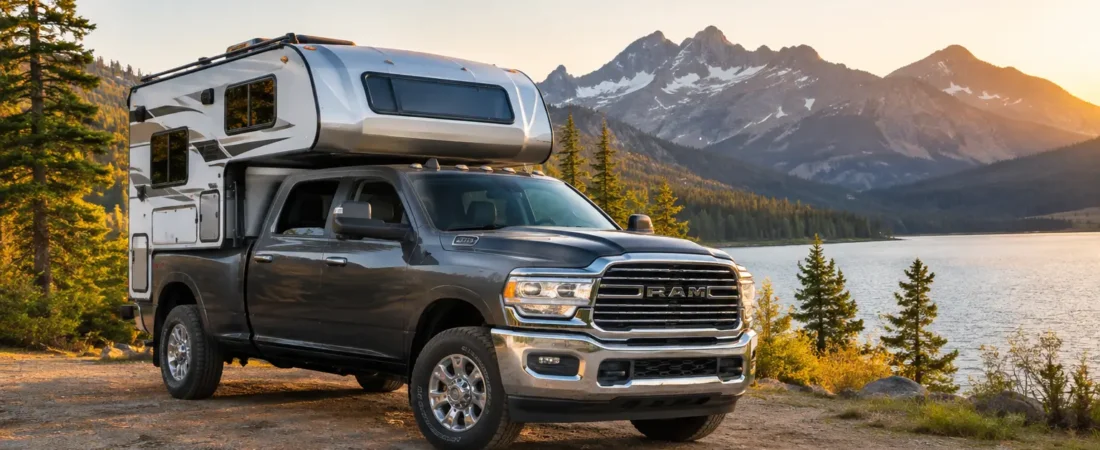
A truck camper has a way of making every weak link obvious. Add a tall camper, water, recovery gear, coolers, power stations, solar, and the rest of the stuff that turns a quick overnight into a comfortable few days outside, and the truck is doing real work. That is where our Ram 3500 review starts: not with a parking-lot test drive, but with a Four Wheel Camper Project M mounted on the back.
Our truck is a Ram 3500 dually, and it is the foundation of our truck-camper setup. It gets us to camp, carries the gear that lets us stay a little longer, and gives us confidence when pavement turns into washboard, ruts, or a narrow forest road with nowhere convenient to turn around. It is not small, cheap to feed, or especially subtle. It is also a very practical tool for the kind of travel we enjoy.
Ram 3500 Review From a Truck Camper Owner
The biggest reason to consider a Ram 3500 for a camper is simple: payload and stability matter more than almost anything once the truck is loaded. A Project M is not a giant hard-sided RV, but it is still meaningful weight high in the bed. Then come people, water, food, a Dometic or ICECO cooler, camp chairs, recovery gear, firewood, and the dozen small things that somehow multiply before departure.
Our setup also carries serious power capability. We use an EcoFlow Delta Pro 3, a Bluetti Elite 300, and 600 watts of Renogy solar on top of the camper. That setup helps make camp more comfortable, especially when we use the EcoFlow AC unit, but batteries and solar equipment are not weightless. Neither are a Carbon Offroad Pro 20K winch, front lighting, rock lights, an awning, or a propane fire pit.
A dually gives the rear of the truck a planted feel under that kind of load. The wider rear stance is noticeable when crosswinds pick up or when a passing semi creates that familiar push-pull on the highway. A properly loaded single-rear-wheel truck can absolutely be a great camper platform, depending on the camper and actual scale weight. But for our use, the extra stability of the dual rear wheels is part of why the Ram 3500 makes sense.
The important phrase is “properly loaded.” Do not choose a truck based on a camper’s dry weight alone. Check the truck’s specific payload sticker, axle ratings, tire ratings, and the real weight of the camper after adding water, batteries, gear, and passengers. A scale ticket may not be exciting content, but it is a lot more useful than optimism.
The Ride Is Better Than a Work Truck Has Any Right To Be
Our Ram 3500 has a Carli full Dominator suspension, which changes the conversation considerably. Heavy-duty trucks are built to carry and tow, not float over broken pavement like a luxury SUV. Stock or modified, a 3500 is still a big truck with heavy-duty priorities. You feel expansion joints, potholes, and washboard. The point is not to pretend otherwise.
With the Carli suspension, the truck feels more controlled on rough roads than the factory work-truck stereotype would suggest. It helps reduce the sharp, busy behavior that can wear you out on long travel days, and it gives the truck more composure when roads get uneven. That matters with a camper mounted high behind the cab.
We also run ARB air lockers, which are useful when traction becomes the limiting factor. They are not permission slips to take a dually down every sketchy trail. A long, wide truck with a camper has real limits on tight turns, breakover angles, tree branches, and off-camber terrain. Lockers can help on loose climbs, muddy approaches, and uneven ground, but judgment still does most of the work.
That is one of the more honest parts of owning this setup: it is capable, but it is not a small trail rig. We are always reading the road ahead, looking for turnarounds, and deciding whether the destination is worth dragging a wide rear end through a tight section. Sometimes the smart move is parking earlier and enjoying the walk.
Where a Dually Makes Everyday Travel Harder
The Ram 3500 dually is comfortable in its lane, but it takes up plenty of it. Parking lots, drive-thrus, old fuel stations, and narrow camp roads all require a little more attention. The rear fenders are expensive reminders that the truck is wider than it looks from the driver’s seat.
Fuel stops are probably the most routine adjustment. We look ahead for open lanes, avoid cramped stations when possible, and leave ourselves room to exit without turning a simple fill-up into a three-point maneuver. This is not difficult after a while, but it does change how you travel. You start appreciating truck-friendly stations, big parking lots, and campsites with room to back in.
There is also the question of tires. Six tires means more expense when replacement time comes, and maintaining proper tire pressure matters. A dually’s rear tires are a major part of its load-carrying and stability advantage, so they are not something to ignore until a trip is already underway.
Then there is fuel economy. A heavy-duty diesel truck carrying a camper, packed with gear and pushing a tall profile through the wind, will not sip fuel. The exact result changes with speed, terrain, wind, tire choice, and load. We plan for fuel stops rather than chasing a perfect number. Slowing down a little often makes the drive calmer anyway, which fits the whole point of getting out there.
The Camper Setup Is What Makes the Truck Worth It
A Ram 3500 without a job is still a big truck. With the Project M on the back, it becomes a base camp that can move. The truck gets us to a lake, a quiet stretch of public land, or a road-trip stop where the plan is simply to make dinner, sit outside, and stay put long enough to notice the sunset.
The Alu-Cab Shadow awning gives us shade when the afternoon heat is doing its Texas thing. The Zero23 Rask shower is one of those comforts that feels unnecessary until a dusty day makes it very necessary. Baja Designs ditch lights, Rigid front bumper lighting, and Oracle rock lights help with visibility and setup when daylight runs out before camp is ready.
None of that gear turns the truck into an invincible overland machine, and it does not need to. The goal is a setup that supports more time outside with fewer reasons to head home early. Cold food stays cold. Batteries stay charged. Shade is available. Recovery gear is there for the day conditions surprise us. Then the best part of camp can happen: no plans, no scripts, good times, long clips.
Who Should Consider a Ram 3500?
A Ram 3500 is worth considering if your truck will regularly carry a substantial camper or tow heavy equipment while loaded for travel. It is particularly appealing for people who value a stable towing and hauling platform more than easy city parking. If your trips include long highway miles, gravel roads, weather changes, and a camper packed for several days, the heavy-duty capability is reassuring.
It may be more truck than some people need. If your camper is light, your gear list is short, and your travel stays close to pavement, a smaller truck can be easier to park, easier to maneuver, and less expensive to run. There is no prize for buying the largest truck possible. The right answer depends on actual weights, where you plan to drive, how often you tow, and how much compromise you are willing to make at the grocery store or fuel pump.
For us, the compromises are part of the deal. The Ram 3500 dually is big because our travel setup is big, at least compared with a simple tent and a cooler. In exchange, we get a truck that carries our Project M with confidence and lets us bring the practical comforts that keep us outside longer.
The best test is not whether a truck looks ready for adventure in a driveway. It is whether it makes it easier to take the trip when Friday finally gets here. If a heavier-duty setup means you can load up, leave the noise behind, and spend another unhurried morning at camp, that is a trade worth considering. Stop feeding the scroll. Come camp with us and let your world slow down.