
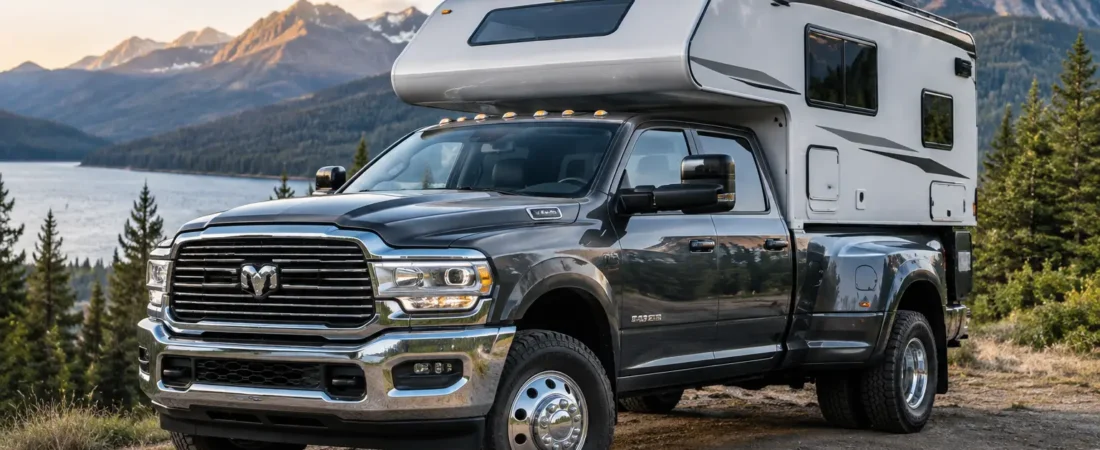
A truck can look perfectly level in the driveway and still be carrying more than it should. That is why a good ram 3500 payload guide starts with numbers, not appearance. When you add a truck camper, water, batteries, recovery gear, people, dogs, food, and the pile of “just in case” stuff that somehow always comes along, weight adds up fast.
We run a Four Wheel Camper Project M on a Ram 3500 dually, so this is not a theoretical topic around here. The point is not to chase the biggest payload number in a brochure or turn every camp trip into a math assignment. It is to understand what your particular truck is carrying, leave room for real life, and spend less time wondering about every bump, crosswind, and downhill curve.
Ram 3500 Payload Guide: Start With Your Door Sticker
The most useful payload number is on your truck, not a generic online specification chart. Open the driver-side door and look for the Tire and Loading Information label. It includes wording similar to: “The combined weight of occupants and cargo should never exceed” followed by a number.
That number is the payload rating for that specific Ram 3500 as it left the factory. It accounts for the truck’s original configuration, which matters because Ram 3500 payload ratings can vary a lot. Cab style, bed length, gas or diesel engine, trim level, two-wheel drive or four-wheel drive, single rear wheel or dual rear wheel, and factory options all affect the available capacity.
A well-equipped diesel truck can weigh substantially more than a simpler configuration. Leather seats, larger wheels, power steps, a sunroof, and other comfort options are all nice on a long drive, but they do not disappear when it is time to carry a camper.
For truck-camper owners, a dually often provides more payload capacity and a wider rear stance than a single-rear-wheel truck. That can be a big confidence booster with a tall load. Still, “dually” is not a free pass to skip the scale. Every truck has its own sticker, axle ratings, tire limits, and real-world loaded weight.
Payload Is More Than the Camper’s Listed Weight
The dry weight printed on a camper spec sheet is a starting point, not your loaded camping weight. It may not include water, propane, batteries, optional equipment, bedding, food, gear, or the items installed after purchase. If a camper company lists several weights, read the fine print and find out exactly what each number includes.
Then add everything that rides in or on the truck. That means passengers, pets, tools, recovery boards, a winch, auxiliary lighting, hitch equipment, coolers, camp chairs, clothing, fishing gear, and groceries. If it crosses the truck’s threshold or mounts to the truck, it counts.
Water deserves special attention because it is easy to overlook. Fresh water weighs a little over 8 pounds per gallon. A 20-gallon tank adds more than 160 pounds before you pour a cup of coffee. That is not necessarily a problem, but it is a meaningful change when your payload margin is already tight.
Our own kind of setup shows how quickly the extras stack up. A Project M is only part of the story. Power stations, solar panels, a cooler, an awning, a shower setup, recovery equipment, and the ordinary things that make camp comfortable all have a place in the calculation. None of those pieces is outrageous by itself. Together, they are the real load.
The Scale Is the Answer, Not the Guess
A public scale is the best tool in this whole process. Weigh the truck in the condition you actually travel: camper loaded, fuel where you normally keep it, water onboard if you travel with water, passengers inside, and the usual gear packed. A nearly empty truck weighed on a Tuesday afternoon does not tell you much about a Friday departure for a long weekend.
The most helpful ticket gives you separate steering-axle, drive-axle, and total vehicle weights. Compare the total weight to the truck’s gross vehicle weight rating, or GVWR. Then compare each axle weight to the gross axle weight rating, or GAWR, listed on the certification label on the driver-side door area.
This is where many payload conversations get incomplete. You can be under the truck’s total GVWR while placing too much weight on the rear axle. Truck campers naturally put much of their mass behind the cab, and the camper’s center of gravity matters. A camper that carries its weight farther rearward can change handling and rear-axle load more than a similar-weight camper with its mass positioned farther forward.
Tire ratings matter too. Tires are the final connection between the truck and the road. Their load capacity must support the weight carried at each axle, and they need to be inflated according to the tire manufacturer’s load-and-pressure guidance. A tire’s maximum pressure molded into the sidewall is not a universal instruction for every situation, but underinflation for a heavy load is not something to gamble on.
Leave a Margin You Can Actually Live With
Being exactly at a rating is not a relaxing way to travel. A scale ticket reflects one moment in time, and camping loads change. You may leave home without full water tanks, then top off near camp. You may pick up firewood where it is permitted, bring home wet gear, or add another passenger for a day trip.
A practical margin gives you options. It also makes it easier to stay honest when the gear pile grows. The goal is not to pack fearfully. It is to avoid the slow drift where every new accessory seems small enough to ignore.
If your numbers are close, start with the easy questions. Do you need to carry full water for the whole drive? Can heavier gear move forward in the truck or camper? Are duplicate tools, oversized storage boxes, or rarely used items taking up weight for no real benefit? Sometimes the fix is simply packing with more intention.
There are also situations where the better answer is a lighter camper, fewer installed accessories, or a truck with more capacity for the intended build. That can feel less exciting than adding one more piece of gear, but it usually leads to a calmer truck and a more enjoyable trip.
Suspension Upgrades Help, But They Do Not Create Payload
This is one of the biggest misunderstandings in truck-camper circles. Quality suspension upgrades can improve ride, control, and confidence. They can reduce squat, help manage body motion, and make a heavily loaded truck feel more composed. Our Ram has a Carli Dominator suspension, and upgrades like that can make a meaningful difference in how a loaded rig behaves.
But suspension parts do not automatically increase the manufacturer’s GVWR, axle ratings, or the legal capacity of the truck. The same goes for airbags, helper springs, wheels, and other common upgrades. They may solve a handling issue, but they do not erase a weight issue.
Treat ride quality and weight ratings as related but separate conversations. A truck that sits level can still be overloaded. A truck that is within its ratings can still benefit from better shocks, tire choices, alignment, or load organization.
Don’t Forget Towing and Tongue Weight
If you tow behind a truck camper, the trailer’s tongue weight becomes truck payload. This matters for a boat trailer, utility trailer, or flat-towed setup with any hitch-mounted equipment. The trailer may be behind the truck, but the weight pressing down on the hitch is being carried by the truck’s rear axle.
That is why a truck that works beautifully with a camper alone may need another scale visit once towing is added. Weighing the combination is the cleanest way to see what changed. It also helps confirm that the front axle has not become too light, which can affect steering feel and braking stability.
A Simple Pre-Trip Weight Routine
You do not need to weigh the truck before every overnight stop. But it is smart to get a true loaded baseline after a major change: adding the camper, installing heavy gear, changing tires, adding a winch, or beginning to tow something new.
Keep the scale ticket with your truck paperwork and write down the conditions of that weigh-in. Note whether the water was full, whether you had passengers aboard, and what major equipment was installed. A few notes make the number far more useful months later when you are trying to remember whether that 11,000-pound reading included the cooler, kayaks, or a full tank of water.
The best truck camper setup is not the one with the most accessories bolted to it. It is the one that carries what helps you get outside, drives predictably, and leaves enough room to enjoy the road. Check the numbers, pack with a little restraint, then stop feeding the scroll and let the world slow down.