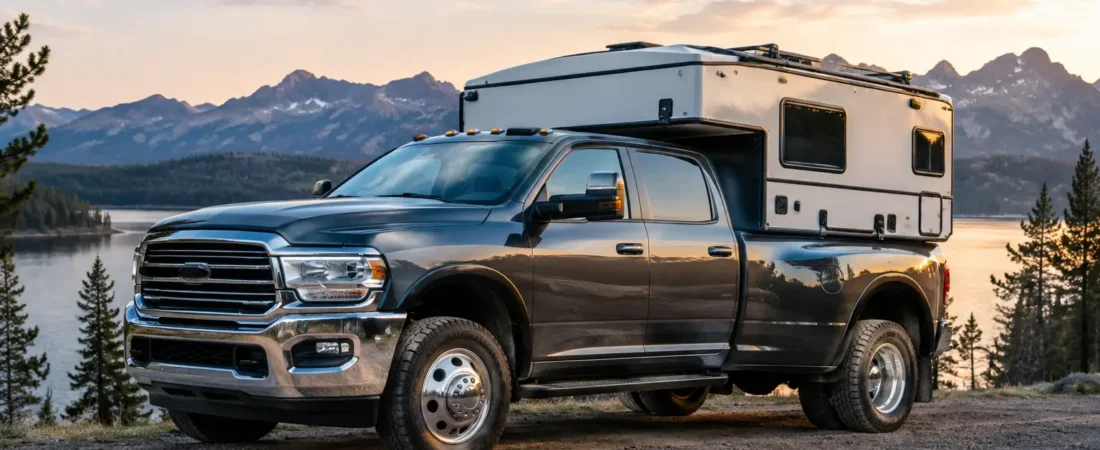
A Project M build can look wildly different depending on where you camp, how much gear you carry, and whether your idea of a good weekend involves a quiet lakeside site or a long washboard road to nowhere in particular. Our Project M build starts with a Ram 3500 dually because we wanted a truck-camper setup that feels capable without turning every camp trip into a complicated production.
The Four Wheel Camper Project M gives us the basic things that matter most: a comfortable place to sleep, shelter when the weather turns, and a fast way to settle in after a day on the road. From there, the build is less about bolting on every possible accessory and more about making the truck work for the way we actually camp.
Why We Started With a Ram 3500 Dually
A camper build is really a weight-management project wearing hiking boots. Before choosing lights, power stations, coolers, or recovery gear, it helps to understand what the truck can safely carry.
The Project M is designed as a pop-up truck camper, which keeps height and weight more reasonable than many hard-sided options. Even so, camper weight is only part of the equation. Add passengers, water, food, tools, a fridge or cooler, solar panels, camp chairs, recovery equipment, and the random things that seem necessary five minutes before departure, and the numbers rise fast.
That is why the Ram 3500 dually made sense for us. The dual rear wheels provide a stable platform for carrying a camper and loaded travel gear. It is not the smallest or easiest rig to park at a crowded grocery store, and nobody is calling a dually nimble in a drive-thru. But for our use, the extra capability and planted feel are worthwhile trade-offs.
The truck also has Carli full Dominator suspension and ARB air lockers. Suspension upgrades do not make a heavy truck weightless, and lockers do not turn a big camper rig into a rock crawler. They do, however, support a more controlled ride and offer useful traction when a road is loose, rutted, muddy, or just more interesting than expected.
The Project M Build Is About Time Outside
The best part of a Project M is not a spec sheet. It is getting to camp without spending an hour building camp first.
A pop-top camper lets us pull in, open up, and start making dinner while there is still daylight. That sounds simple, but it changes the pace of a trip. We can take a longer scenic route, stop for a lake sunset, or linger after a kayak paddle without worrying that setup will become the whole evening.
Our approach is to keep the truck ready enough that a free weekend does not require a giant packing list. No plans. No scripts. Good times. Long clips. The goal is not to be perfectly prepared for every imaginable scenario. It is to have the basics organized well enough that getting outside feels easier than staying home and feeding the scroll.
Power That Matches How We Camp
Power is one of the most personal parts of any truck camper setup. Some campers only need enough electricity for lights, phones, and a small fan. Others need power for camera batteries, laptops, refrigeration, or climate control. It depends on the season, trip length, weather, and how much time you want to spend managing batteries.
We use an EcoFlow DELTA Pro 3 with 600 watts of Renogy solar panels on top, along with a Bluetti Elite 300. That combination gives us flexibility instead of tying every electrical need to one device. The larger power station can handle heavier demands, while the smaller unit is useful where a portable power source makes more sense.
Solar is especially helpful when camp is sunny and stationary. It is less magical under heavy tree cover, during stormy weather, or on short winter days. That is a good reminder that solar capacity and solar production are not the same thing. A panel can be mounted on the roof, but shade still gets a vote.
We also have an EcoFlow AC unit. Air conditioning can make hot-weather trips more comfortable, but it requires realistic expectations. Running AC from battery power is not a set-it-and-forget-it plan for every campsite or every night. It works best when the full system, battery capacity, charging opportunities, outside temperature, and desired runtime have all been considered before leaving the driveway.
Cooling, Cooking, and the Camp Routine
Food storage is where a build becomes real fast. It is easy to picture a beautiful truck in the mountains. It is less glamorous to picture where the burgers, drinks, breakfast, and ice are going to live on day three.
We use both a Dometic cooler and an ICECO cooler, depending on the trip and what needs to come along. Having more than one cooling option gives us room to separate drinks from food or bring additional cold storage when the trip calls for it. The trade-off is space and power use, so packing with purpose matters.
At camp, the Alu-Cab Shadow Awning creates shade quickly, which can make a huge difference in Texas heat or any bright, exposed site. Shade makes cooking less miserable, gives wet gear a place to hang out, and creates an outdoor living area that feels bigger than the truck itself.
We also use a Zero23 Rask shower and a LavaBox stainless steel propane fire pit. Neither is a requirement for camping, but both can improve comfort in the right situation. The shower is useful after dusty roads, sandy feet, or time on the water. The propane fire pit is convenient where allowed, but local fire restrictions always come first. A good campfire is never worth creating a bad situation.
Recovery Gear Is Not a Personality Trait
A Project M build can carry you farther from pavement, but that does not mean every trip needs to test the limits of the truck. We would rather use capability to avoid trouble than use it to create trouble.
Our Ram has a Carbon Offroad Pro 20K winch, plus additional lighting from Baja Designs ditch lights, Rigid front bumper lighting, and Oracle rock lights. A winch is there for recovery, not entertainment. Extra lighting can be helpful for camp setup, trail visibility, and spotting obstacles, but it should be used thoughtfully around other campers and on public roads.
Recovery gear also works best as part of a bigger plan. Check road conditions, know the weather forecast, carry the right gear, travel within the limits of the vehicle, and be willing to turn around. The most experienced-looking decision is often the boring one: backing out before a muddy two-track becomes an all-day project.
Storage Is the Part Nobody Sees Online
The difference between a fun truck-camper trip and a frustrating one is often storage. Gear needs a home, and it needs to go back to that home when camp is packed up in the dark or while rain is coming sideways.
We try to keep frequently used items accessible: recovery gear, leveling supplies, cooking tools, charging cables, basic first aid, and rain layers. Items used only at camp can live deeper in the storage plan. Heavy gear should be secured and placed with weight distribution in mind, not tossed wherever it happens to fit.
This is also where a build keeps evolving. The first version of a storage system rarely survives a full season unchanged. A bin may be too large, a drawer may be hard to reach with the camper loaded, or the thing you thought you would use every day may stay untouched for six trips. Those are not failures. They are the useful details that turn a pile of gear into a setup that fits your life.
Build for the Trips You Actually Take
A Project M build does not need to copy anyone else’s truck. A weekend camper near Texas lakes may prioritize shade, cold drinks, and room for kayak gear. Someone heading into colder mountain weather may care more about insulation, traction, and battery management. A couple traveling with kids will organize the same camper very differently than two adults traveling light.
For us, the point of the Ram 3500 and Project M is simple: make it easier to say yes to a camp weekend, a road trip, or a slow few days somewhere with fewer notifications and better sunsets. Start with safe payload, solve the power and storage needs that genuinely affect your trips, then let the build earn its additions one adventure at a time. Stop feeding the scroll. Come camp with us and let your world slow down.