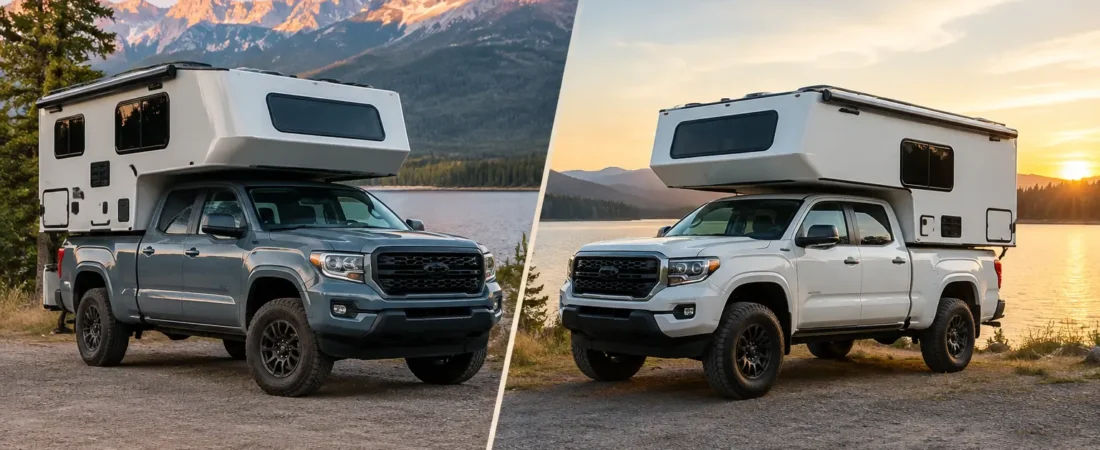
The project m vs tune m1 question usually starts with a simple goal: get the truck out of the driveway more often without turning every weekend into a packing project. Both are lightweight, wedge-style truck campers that keep a lower profile than a traditional slide-in camper. But they take noticeably different paths to that same goal.
We run a Four Wheel Campers Project M on a Ram 3500 dually, so we can speak from real use on that side of the comparison. We have not camped in a Tune M1, and we are not going to pretend otherwise. This is a practical look at where each camper appears to make sense, plus the things worth measuring before you commit to either one.
Project M vs Tune M1: The Big Difference
The Four Wheel Campers Project M is built around a straightforward idea: turn your truck bed into a weather-protected base camp while keeping the camper simple enough to customize around your own style of travel. It is a pop-up topper camper, meaning it mounts to the truck bed rails rather than sitting inside the bed like a traditional slide-in. The bed stays available for gear, coolers, recovery equipment, bikes, storage drawers, and whatever else seems essential on Friday afternoon.
The Tune M1 is also a pop-up truck camper, but its design leans harder into an enclosed, molded-composite style of shell. Its distinctive shape and integrated feel appeal to people who want a finished, purpose-built space rather than an aluminum-framed platform they will build out over time.
That difference matters more than marketing language. The Project M tends to suit owners who enjoy configuring their truck around changing trips. The M1 may appeal more to someone who values a more refined enclosure, a specific interior layout, and the visual simplicity of a single molded unit.
Neither approach is automatically better. It depends on whether your truck camper is mainly a sleeping platform, a self-contained travel space, or a base for hauling a lot of outdoor gear.
The Project M Makes Sense When the Truck Bed Is Your Gear Room
One of the best parts of the Project M is that it does not force every owner into the same setup. That freedom can be a blessing and a small headache. You get to decide where power lives, how drawers are arranged, whether you want a fridge slide, how much open floor space to keep, and what comes along on each trip.
Our setup reflects that flexibility. We use portable power, including an EcoFlow Delta Pro 3 and Bluetti Elite 300, plus 600 watts of Renogy solar on top. We also carry a Dometic cooler and an Iceco cooler depending on the trip. That arrangement would not be everyone’s choice, but that is the point. A Project M can be shaped around how you actually camp instead of how a brochure says you should camp.
For us, the Ram’s bed is also part of the adventure plan. The Alu-Cab Shadow awning creates a useful outdoor living area, and the Zero23 Rask shower gives us an option for rinsing off after dusty roads or lake days. When the weather is nice, the camper is mostly where we sleep and keep our essentials dry. The camp happens outside.
That is worth thinking about honestly. If you like cooking, sitting, and hanging out under an awning, a simpler interior is not necessarily a compromise. If you routinely travel in cold, wet weather or want to spend long evenings inside, interior layout and insulation become much bigger factors.
A simple camper still needs a plan
The Project M’s open-bed concept is practical, but it rewards organization. Loose camp gear can turn into a game of moving five things to reach one thing. Storage boxes, tie-downs, drawers, and a consistent packing routine make a huge difference.
It also helps to think through access with the roof down. Can you reach water, recovery gear, food, jackets, and bedding during a quick roadside stop? Can you open the tailgate around a trailer tongue or gear rack? These are not glamorous questions, but they decide whether a truck setup feels easy or fussy six months later.
Where the Tune M1 May Be the Better Fit
The Tune M1’s molded-composite construction is a major part of its appeal. A composite shell can offer a very clean exterior and may reduce some of the maintenance concerns people associate with multi-panel camper designs. For buyers who want a more finished-feeling camper from day one, that can be compelling.
Its wedge profile is also a natural fit for people who want to keep their truck relatively nimble while gaining a protected sleeping area. A low roof can matter on forest roads, in wind, at fuel stations, and in the everyday reality of parking a truck at home or work.
The M1 may be especially attractive if you want the camper itself to feel like a contained room. Some travelers would rather have fewer decisions about cabinetry, finishes, and system placement. They want to load clothes, food, and bedding, then leave when the work week ends. There is nothing wrong with that. Not every outdoor setup needs to become a garage project with three wiring diagrams and a list of parts taped to the refrigerator.
Still, a more integrated design can bring trade-offs. Custom changes may be less straightforward than they are in an open-bed camper. Repairs, accessory mounting, and future system upgrades deserve careful research. Ask how electrical components, roof hardware, windows, seals, and interior panels can be serviced. A beautiful build is more useful when you understand how it will be maintained years from now.
Payload Is More Important Than the Camper Brochure
The biggest mistake in any Project M vs Tune M1 comparison is looking only at dry camper weight. Dry weight is just the starting line.
Add people, water, batteries, solar, coolers, tools, bedding, food, a winch, recovery gear, an awning, and that “one small camp chair” that somehow has friends. The real number climbs fast. If you tow, tongue weight also affects the truck’s rear axle load. If you carry a boat trailer, teardrop, or flat-tow vehicle on different trips, the math changes again.
Our Ram 3500 dually gives us a strong foundation for a loaded truck camper setup, but that does not mean we ignore weight. The truck has Carli Dominator suspension, ARB air lockers, a Carbon Offroad Pro 20K winch, and additional lighting, all of which are useful pieces of the overall build. They also remind us that every modification has a weight, wiring, clearance, or maintenance consequence.
Before ordering either camper, use the payload sticker on the actual truck, not a payload number from a similar trim online. Then weigh the truck as it travels: full fuel, passengers, installed accessories, and the gear you realistically bring. Compare axle ratings and tire ratings too. A truck that looks level in a parking lot is not automatically within its ratings.
Weather, Comfort, and How You Actually Spend a Rainy Day
Both campers are meant to get you off the ground and out of a tent, but no lightweight pop-up should be judged like a hard-sided cabin. Pop-up fabric walls bring ventilation, lower weight, and a compact travel height. They can also bring more outside noise, more temperature swings, and more awareness of wind and rain.
For fair-weather camping in Texas, New Mexico, and much of the West, the pop-up format is hard to beat. You get an elevated sleeping space and a truck that is still ready for dirt roads, boat ramps, and everyday errands. On a windy night, though, you will know you are camping. That is not a flaw. It is just part of the trade.
Think about the trips you want, not the trips that look cool in a photo. If most of your nights are warm-weather weekends, ventilation and easy setup may matter more than maximum insulation. If shoulder-season trips, mountain weather, or extended rain are central to your plans, study each camper’s cold-weather options, condensation management, heater placement, and interior living space.
Choose the Camper That Leaves Room for the Trip
The Project M is a strong match for people who want an adaptable truck bed, enjoy building their own systems, and prefer to keep camp centered outside under an awning. The Tune M1 may fit better for buyers drawn to composite construction, an integrated form, and a more finished camper experience.
The right answer is often less about which camper has the better feature list and more about which one will make you leave on a random Thursday night. Measure your truck, weigh your real gear, sit inside both campers if possible, and picture a wet morning, a hot afternoon, and a late arrival after a long drive. The best setup is the one that gets you away from the screen and gives you more unhurried mornings outside.