
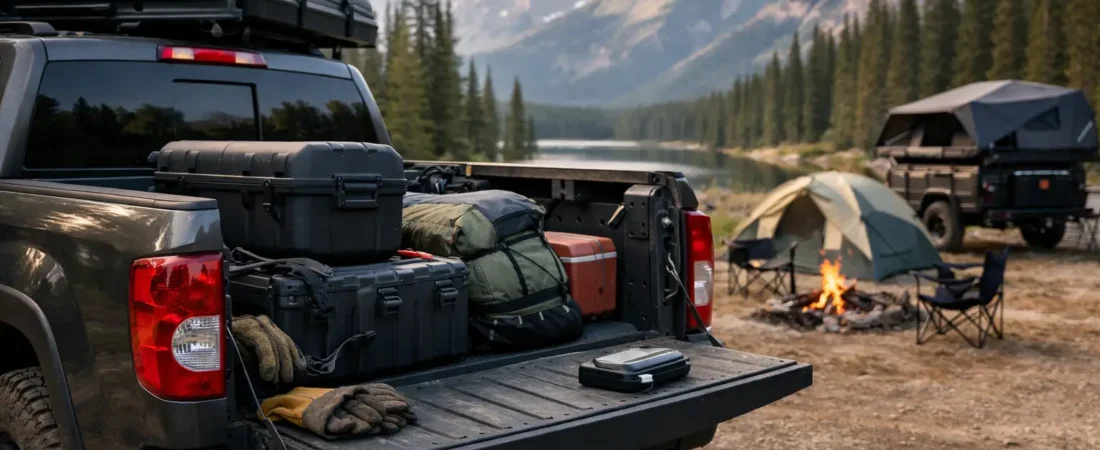
A truck can feel like it has endless capacity right up until you add a camper, passengers, recovery gear, a cooler, water, and the random stuff that somehow becomes essential by Friday afternoon. Then the question is no longer whether the truck can move it. The real question is how to manage truck payload without guessing and without finding out the hard way on a rough road, steep grade, or emergency stop.
For truck camping and overlanding, payload is one of those numbers that sounds boring until it affects how the whole rig handles. It influences braking, tire heat, suspension travel, steering feel, stability in wind, and even whether that favorite dispersed campsite road is a good idea. A little planning here buys a lot more peace of mind once the pavement ends.
Start With the Payload Sticker, Not a Brochure
Every truck is different, even trucks with the same make, model, engine, and trim. Options such as four-wheel drive, a diesel engine, a sunroof, larger cab, factory accessories, and luxury interior packages all add weight before you ever load the truck.
The most useful starting point is the Tire and Loading Information label, usually found on the driver’s door jamb. It lists the maximum combined weight of occupants and cargo for that specific truck as it left the factory. That number is more relevant than a broad payload figure from an online spec sheet.
Payload includes nearly everything added to the truck after it left the factory: people, pets, a slide-in or flatbed camper, tools, coolers, fuel cans, water, food, hitch hardware, recovery equipment, and cargo in the cab or bed. If it rides on the truck, it counts.
A common mistake is treating a camper’s published dry weight as the final number. Dry weight often excludes water, propane, batteries, options, bedding, cookware, and the gear that makes camping comfortable. It is a starting point, not a loaded travel weight.
Know the Numbers That Work Together
Payload matters, but it is not the only limit. A smart loading plan looks at several ratings together.
Gross Vehicle Weight Rating, or GVWR, is the maximum allowed weight of the fully loaded truck. Gross Axle Weight Ratings, or GAWRs, are the maximum weights allowed on the front and rear axles. Tire load ratings also matter, because tires are the final connection between all that weight and the road.
If you are carrying a truck camper, rear axle weight often becomes the number that deserves the closest attention. Campers naturally place a lot of their weight toward the back of the truck, and loading heavy gear behind the rear axle can magnify that effect. A truck may be under its GVWR but still overloaded on the rear axle or rear tires.
For towing, tongue weight counts as payload too. A trailer that seems light on paper can still put several hundred pounds or more onto the truck through the hitch. That is especially worth remembering with a teardrop trailer, where the truck may already be carrying passengers, camping gear, and recovery equipment.
Get Real Weights at a Public Scale
The best way to replace assumptions with facts is to weigh the truck. A public CAT scale, recycling center scale, quarry scale, or other certified vehicle scale can give you a useful snapshot of where the rig stands.
Start by weighing the truck as you normally drive it. Include the people who will be in it, the camper if mounted, typical fuel level, water, propane, food, coolers, and gear. It does not need to be packed perfectly for every possible trip, but it should reflect reality. Weighing an empty truck and calling it good is like checking the weather from the couch.
When possible, get separate front and rear axle weights, not just a total. Compare each axle number with the GAWR listed on the driver’s door label. Then compare the overall weight with the truck’s GVWR. Finally, verify that each tire’s load rating supports the weight carried by that axle.
For a Ram 3500 dually with a Four Wheel Camper Project M, the dually platform provides a much larger margin than many lighter-duty trucks. That margin is useful, but it is still not a reason to stop weighing. Solar panels, power stations, an awning, coolers, tools, water, and all the small camp items add up faster than expected.
How to Manage Truck Payload When Packing
The goal is not to travel with nothing. The goal is to carry what makes the trip better without hauling duplicate, forgotten, or poorly placed weight.
Put dense, heavy items as low and as far forward as practical. Water, tools, recovery gear, batteries, and food storage are better kept near the truck’s center of mass than piled at the very back. This helps reduce rear axle loading and can make the truck feel more settled on uneven roads.
Water deserves special attention because it is heavy and easy to overlook. One gallon weighs a little over eight pounds. A 20-gallon fresh-water supply adds more than 160 pounds before counting the tank itself. Carrying less water can make sense on trips with reliable refill options. On remote routes, carrying more may be worth the payload trade-off. There is no universal answer, just an honest look at the route and your margin.
The same goes for gear. A winch, auxiliary lighting, off-road bumpers, bed systems, rooftop equipment, power stations, and recovery tools can all be useful. They also need to be counted. The Carbon Offroad Pro 20K winch, for example, is not just a line item on a build list. It is weight on the front axle. A power setup with an EcoFlow Delta Pro 3 and 600 watts of rooftop solar makes camp more comfortable, but it belongs in the weight calculation too.
Before a longer trip, we like the simple question: would we notice if this stayed home? Some gear earns its place every time. Some gear has been riding around since last season waiting for its big moment.
Suspension Helps Handling, Not Legal Capacity
This part gets mixed up constantly. Upgraded shocks, springs, airbags, helper springs, sway bars, and premium suspension components can improve how a loaded truck rides and handles. They can reduce sag, improve control, and make rough roads less punishing.
They do not automatically increase the truck’s factory GVWR, GAWR, wheel rating, tire rating, or payload rating.
A quality suspension such as the Carli Full Dominator system can make a loaded truck feel dramatically more controlled, especially on broken pavement and dirt roads. That is a real benefit. But a level-looking truck is not necessarily a properly loaded truck. Airbags can hide squat, and hidden squat can make it easier to overlook an overloaded axle.
Use suspension upgrades to improve the driving experience within safe weight limits, not to justify carrying more than the truck is rated to handle.
Pay Attention to Tires, Pressure, and Ride Feel
Tires are often the forgotten piece of payload management. Check the tire sidewall and manufacturer information for the tire’s load capacity at a given pressure. The combined capacity of the tires on an axle must support the actual measured axle weight.
Run tire pressure appropriate for the load and within the vehicle and tire manufacturer’s guidance. Underinflation creates heat, accelerates wear, and can lead to tire failure. Overinflation can make a truck ride harshly and reduce its contact patch on uneven surfaces. The right pressure depends on the load, tire type, and the guidance that applies to your truck.
Also pay attention to what the truck tells you while driving. Excessive porpoising, wandering, bottoming out, vague steering, uneven tire wear, or a truck that feels pushed around by passing semis are not personality traits. They are reasons to stop and reassess the load, tire pressures, suspension setup, and weight distribution.
Reweigh After Major Changes
Truck setups evolve. One season you may have a basic camp box and a cooler. The next, you have a camper, awning, shower, extra battery power, solar, a fire pit, and a pile of gear for a week away. Every meaningful addition changes the math.
Reweigh after mounting a camper, changing tires or wheels, adding heavy bumpers or a winch, installing a bed system, or altering your power and water setup. If you tow, weigh with the trailer attached and loaded as you travel. It is also worth weighing before and after loading for a particularly long trip if you are close to any rating.
Managing payload is not about turning every camp departure into a spreadsheet exercise. It is about knowing what your truck is actually carrying so the road to camp stays part of the fun. Pack with intention, weigh the real rig, leave yourself some margin, and then stop feeding the scroll. Come camp with us and let your world slow down.