
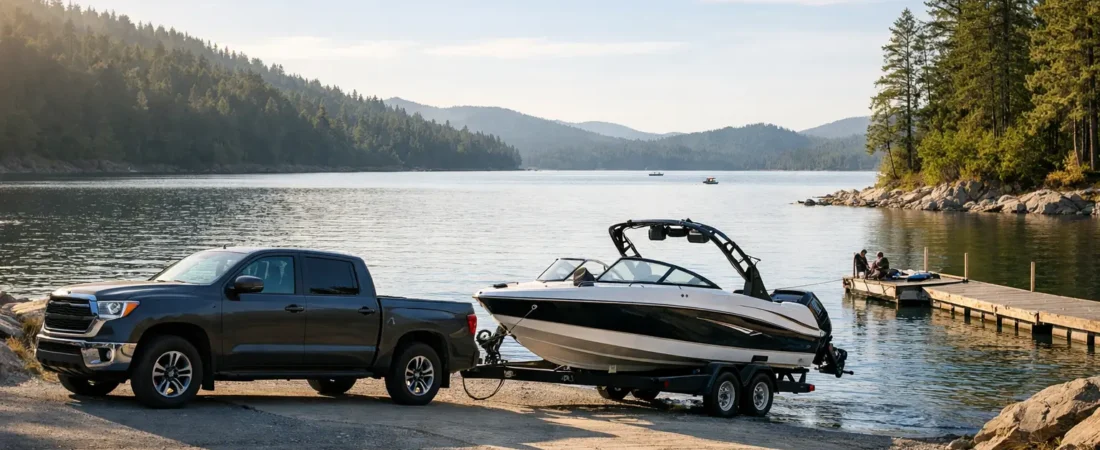
A lake day can go from quiet coffee at the ramp to a sweaty parking-lot puzzle in about five minutes. That is why a beginner guide to boat towing should start before the cooler is packed and the boat is pointed toward the water. Towing a boat is very doable, but it asks you to slow down, know your numbers, and give yourself more room than you think you need.
We use a Manitou XT Tritoon for Texas lake adventures, and one thing boating has reinforced for us is that the fun starts with the boring stuff done right. A secure boat, a capable tow vehicle, and a calm launch routine leave more attention for the water, the people with you, and that first quiet stretch away from the ramp.
Start With the Weight, Not the Sales Brochure
The number that matters is not just the boat’s dry weight. Dry weight often leaves out the trailer, engine, fuel, batteries, anchors, life jackets, coolers, fishing gear, and the random lake-day supplies that always seem to multiply overnight.
Look for the boat’s loaded weight, or build an honest estimate using the manufacturer information for the boat and trailer. Water weighs more than eight pounds per gallon, and fuel adds up fast. Then compare that total with your tow vehicle’s towing capacity, payload rating, gross combined weight rating, and hitch rating. The lowest applicable rating is the limit.
Payload is where plenty of new towers get surprised. Tongue weight presses down on the rear of the tow vehicle, and that weight counts against payload along with passengers, cargo, and anything in the bed or cabin. A vehicle may have enough advertised towing capacity for a boat package while running short on payload once the family and weekend gear climb aboard.
If the numbers feel close, do not treat the limit like a finish line. More margin generally means a calmer tow, better braking, and less strain on the vehicle. A public scale is one of the best ways to replace guesses with real numbers after the boat is loaded as you normally travel.
Set Up the Trailer Before You Need It
A trailer that looks fine in the driveway can reveal a problem at highway speed. Before each trip, take a few unhurried minutes to inspect the basics. Check tire pressure when the tires are cold, look for cracking or uneven wear, test the lights, and make sure the coupler is fully seated and locked onto the ball.
Safety chains should cross beneath the hitch. That gives the trailer tongue a little support if it ever comes loose. Connect the breakaway cable to the tow vehicle separately from the chains. It should be short enough to activate the trailer brakes if the trailer separates, but not so short that it gets pulled tight during a normal turn.
The boat itself needs attention too. Confirm the bow is snug against the bow stop, the winch strap is in good condition and locked, and the safety chain is attached. Secure loose gear inside the boat, install the drain plug before launch, and remove it when the boat is back on the trailer for the trip home. That tiny plug has probably caused more frustrating ramp moments than it deserves.
If your trailer has brakes, learn whether they are surge brakes or electric brakes and how they should feel. A brake controller may need adjustment for electric trailer brakes. The goal is controlled, even braking, not a trailer that shoves the tow vehicle or grabs hard enough to make every stop uncomfortable.
A Beginner Guide to Boat Towing on the Road
The biggest adjustment is simple: everything happens sooner. Accelerating takes longer, stopping takes longer, and turning requires a wider path. Leave a larger following distance than you would in an unloaded vehicle, especially when traffic is moving quickly or the road is wet.
Use your mirrors constantly. You are not staring at the boat every second, but you should regularly check that it is tracking straight, the tires look normal, and the straps have not started flapping loose. Properly adjusted towing mirrors can make a huge difference when the trailer is wider than the tow vehicle.
Avoid sudden steering inputs. If a gust of wind, passing semi, or rough pavement makes the trailer wiggle, resist the urge to jerk the wheel. Keep the steering steady, ease off the accelerator, and let the rig settle. Trailer sway is often a sign of an underlying setup issue such as poor weight distribution, low tire pressure, worn suspension parts, or driving too fast for conditions. Pull over safely and inspect things rather than trying to power through it.
Speed is not just about the posted limit. It depends on wind, road surface, traffic, trailer condition, visibility, and how comfortable the rig feels. Slower is usually cheaper than replacing a tire, a fender, or a boat cushion that took flight somewhere on the highway.
Turns, hills, and lane changes
Start turns wider so the trailer wheels do not cut across curbs, fuel-pump islands, or the edge of a tight driveway. Watch the trailer tires in your mirrors as you turn. It feels awkward at first, then becomes one of those skills your brain handles in the background.
On long grades, use a lower gear or tow/haul mode if your vehicle has one. This can reduce transmission hunting on climbs and provide engine braking on descents. Descend hills at a speed that does not require constant hard braking. If you smell brakes or feel fading performance, pull over safely and let things cool.
For lane changes, signal early, check mirrors twice, and move over gradually. A boat trailer can disappear into blind spots, and other drivers do not always realize how much room you need. Give them less opportunity to surprise you.
Make the Boat Ramp Less Stressful
The ramp is where new boat owners tend to feel watched. The truth is that most regular boaters have had a crooked backup, a forgotten plug, or a launch that took longer than planned. The best ramp etiquette is simply being prepared and staying aware of the line behind you.
Do your setup in the staging area, not at the bottom of the ramp. Load coolers, remove travel covers, put in the drain plug, disconnect any transom tie-downs that need to come off, and have life jackets ready before backing down. Keep the winch strap and bow safety chain connected until the boat is in the water and someone is ready to control it.
Backing up gets easier when you use small steering corrections. Put one hand at the bottom of the steering wheel. Move your hand in the direction you want the trailer to go. If the trailer starts heading left, gently move your hand left. Make a correction, then straighten the wheel and let the trailer respond. Overcorrecting is what turns a small drift into a full parking-lot geometry lesson.
If possible, practice backing in an empty lot before a busy Saturday ramp. Set up a few visible reference points and practice backing straight, making gentle curves, and pulling forward to reset. There is no prize for recovering a bad angle without a reset. Pulling forward and trying again is usually faster than fighting the trailer for five minutes.
At the ramp, use a spotter if you have one. Agree on simple hand signals before you begin. The driver should focus on the spotter, mirrors, and surroundings, while the spotter watches for people, obstacles, and the trailer’s path. Keep communication calm. Nobody backs better because somebody is yelling louder.
Loading Up for the Ride Home
Retrieving the boat deserves the same patience as launching it. Before pulling forward, make sure the boat is centered on the bunks or rollers, the bow is firmly against the stop, and the winch strap and safety chain are attached. Raise the outboard or drive as required for travel, secure loose items, and move out of the ramp lane before doing the rest of your tie-down routine.
At home, rinse equipment as needed for the water you used, inspect the trailer for anything that changed during the trip, and remove the drain plug. A quick walk-around now can catch a low tire, loose strap, or light issue before it becomes next weekend’s problem.
Boat towing is not about looking like the fastest person at the ramp. It is about building a repeatable routine that gives you room to enjoy the day. Take the extra minute, make the reset, and save the rush for getting back out on the water. Stop feeding the scroll. Get the boat hooked up, head for the lake, and let the world slow down.