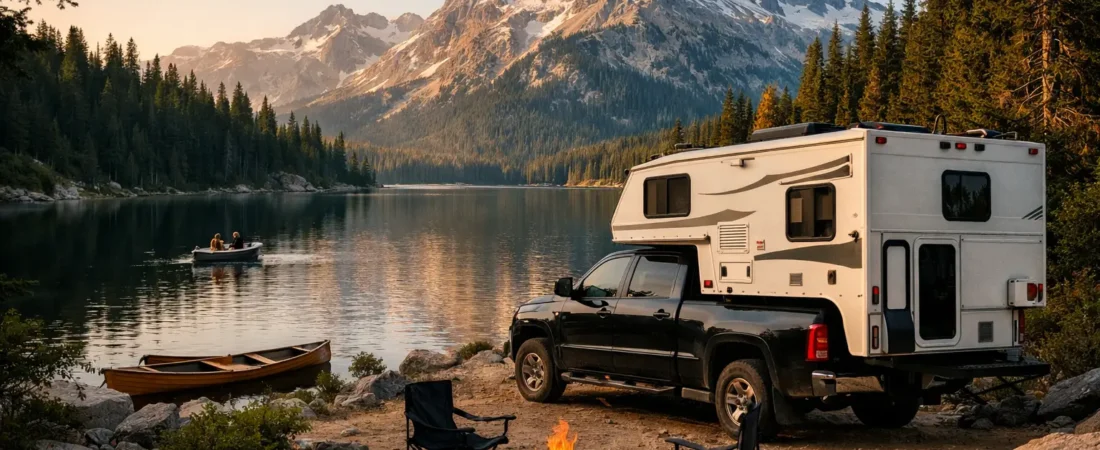
A truck camper changes the math of a weekend. You can leave after work, skip the campground check-in line, and wake up somewhere that feels a long way from the group chat. The best truck camper trips are not always the longest or most remote. Usually, they are the ones with a manageable drive, a simple camp setup, and enough unplanned time to sit outside after dinner.
That is a big reason we like our Four Wheel Camper Project M on a Ram 3500 dually. Once camp is handled, the day can be about a hike, a fishing spot, a backroad, or doing absolutely nothing productive. There is no prize for packing every hour with activity.
Here are seven trip styles worth building around, especially for truck camper owners who want more time outdoors and less time setting up camp.
1. A Texas Hill Country lake weekend
A lake trip is one of the easiest ways to make a truck camper weekend feel like a real reset. Texas Hill Country has plenty of public parks, lakeside campgrounds, and small towns that make good bases for a couple of nights. The appeal is not necessarily technical driving. It is having coffee near the water, getting a kayak in early, and coming back to camp before the afternoon heat starts making decisions for you.
For us, lake days can also mean bringing the Manitou XT Tritoon or the BOTE kayaks when the plan calls for water instead of dirt roads. A truck camper works well here because the sleeping setup stays ready while the day gear changes. One weekend may be about paddling. The next may be about fishing, swimming, or floating around until sunset.
The trade-off is that popular Texas lake areas can fill up quickly, especially on holidays. Reserve sites when a park requires it, and have a backup area instead of betting the whole weekend on one waterfront campsite.
2. A New Mexico high-desert basecamp
New Mexico is made for the kind of trip where the drive is part of the day, not just the thing to survive before camp. High desert country offers big skies, open views, mountain roads, and temperatures that can feel much better than a Texas summer weekend.
A good truck camper strategy is to pick one general area and stay put for two or three nights. Instead of moving camp every day, use the truck to explore nearby scenic roads, trailheads, small towns, or fishing water. It keeps the trip simple and leaves room for the unexpected turn that looks interesting on the map.
This is also where truck size matters. A Ram 3500 dually with a camper is a capable platform, but it is not a narrow trail rig. Some forest roads will be a great fit. Others may have tight trees, soft shoulders, sharp switchbacks, or no place to turn around. Check route conditions, watch the weather, and be honest about your vehicle’s width and turning radius. The best view is not worth a three-point turn that turns into a forty-point turn.
3. A shoulder-season state park trip
State parks are not always the first thing people picture when they think about truck camping, but they can be a smart answer to a short weekend. They often provide a known place to sleep, access to trails or water, and a little more certainty when weather or time is limited.
The trick is going when everyone else is not. A midweek visit, a cool-weather weekend, or the weeks just before and after peak season can completely change the feel of a park. You may still have neighbors, but you can get the quiet morning walk and campfire evening that brought you there.
This kind of trip is also ideal for testing a new system. Try the camper’s power setup, organize your kitchen bins, figure out how long the cooler holds temperature, or see what you actually use during a two-night stay. We run an EcoFlow Delta Pro 3 with 600 watts of Renogy solar on the camper, but every power setup works differently depending on shade, weather, air-conditioning use, and how much time you spend at camp. A nearby state park is a much better classroom than a remote road with no backup plan.
4. A dispersed-camping weekend with a short exit plan
Dispersed camping can deliver the space many people want from truck camping, but it asks for more preparation. The goal is not to drive as far from pavement as possible. The goal is to find a legal, durable place to camp that you can leave without drama if weather changes or the road gets worse.
Before heading out, confirm land-management rules, seasonal restrictions, fire rules, road access, and whether camping is allowed where you intend to go. Conditions can change fast, so current local information matters more than an old pin on a map. Bring enough water, pack out everything, and avoid creating a new campsite where one does not already exist.
A short exit plan is simple: know where you can turn around, know the route back to pavement, and avoid driving farther down a questionable road late in the day. Air lockers, a winch, good lighting, and a well-built suspension can help in the right situation, but they do not make mud, washouts, or narrow trees disappear. Capability is useful. Good judgment is better.
5. A drive-to-the-water fishing trip
Not every truck camper trip needs a huge destination. A fishing-focused weekend can be as simple as finding legal access to a lake, river, or reservoir and giving yourself enough daylight to enjoy it. The camper earns its keep by making early mornings easier. You do not have to break down a tent or drive in from a hotel before the first cast.
Keep the trip loose. Fish in the morning, take a break during the warm part of the day, cook something simple, then head back out when the light softens. If the bite is slow, that is still a day outside. The cooler is cold, the chairs are out, and nobody needs to pretend the schedule is more important than the sunset.
For a boat-based trip, plan the logistics before you leave home. Confirm ramp access, parking room for the truck and trailer, weather, fuel, and local rules. The farther you get from home, the more useful a boring checklist becomes.
6. A two-night road-trip loop
The best truck camper trips do not need a single famous destination. A road-trip loop can be better: one scenic highway, one dirt-road detour that makes sense for your rig, one small-town meal, and two places to sleep.
This format works especially well for couples or families who like variety but do not want to spend the entire weekend driving. Pick a reasonable daily mileage limit and protect it. If you try to cover too much ground, camp becomes a late-night parking exercise instead of the point of the trip.
Build in one flexible afternoon. That may be for a trail, a scenic overlook, a paddle, or the roadside place that does not show up in a trip plan. No plans. No scripts. Good times. Long clips. That is often where the best part of the weekend happens.
7. A camp-and-recover weekend close to home
Sometimes the best answer is the closest one. A nearby campground, public land area, or lake can still give you the break you need if you treat it like a trip instead of a test run. Put the phone away. Cook outside. Set up the awning. Read a book badly because you keep looking at the trees. That counts.
Close-to-home trips also make it easier to bring the gear that improves camp without turning packing into a military operation. An awning can create shade when the sun is working overtime. A portable fire pit can make a cool evening feel like camp even where ground fires are restricted, provided it is allowed and used safely. A quick shower setup can be a nice luxury after a dusty day, but it is not required for a good weekend.
How to choose the best truck camper trip for your rig
Start with the time you actually have, then choose the destination. A two-night weekend is usually better with a shorter drive and a longer stay. A longer trip gives you room for a route with more miles, more stops, and a little more weather flexibility.
Match the road to the vehicle, not the highlight reel. Consider camper height, overall width, weight, fuel range, recovery needs, and where you can safely turn around. Then match camp to the season. Shade, water, wind, bugs, fire restrictions, and temperature can matter more than a view when you are deciding where to spend the night.
The point is not to prove how far your truck can go. It is to make enough space for the day to slow down. Stop feeding the scroll. Come camp with us and let your world slow down.